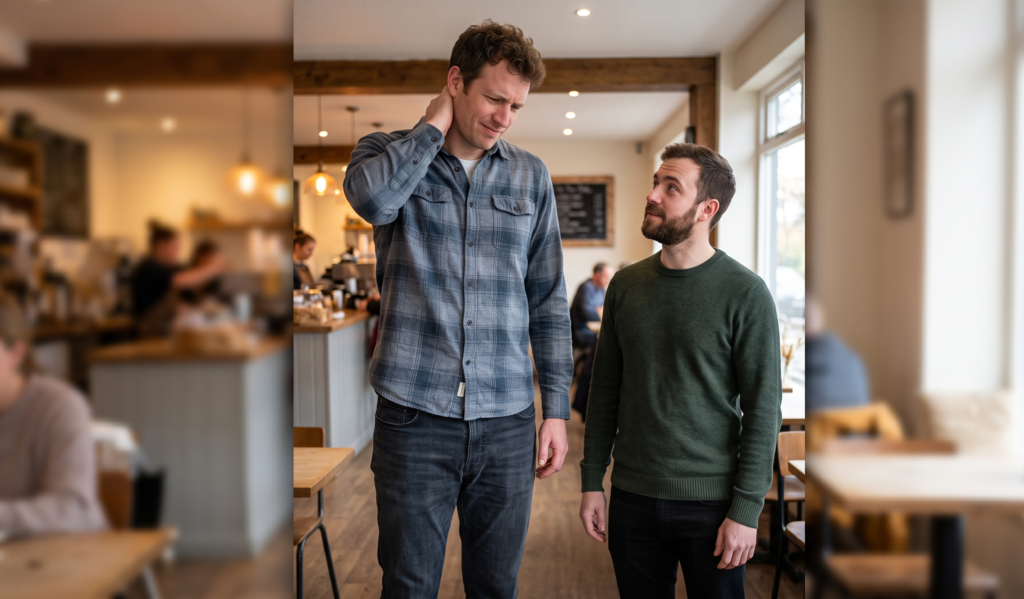
Do Tall People Have More Neck & Back Pain?
A Physiotherapy-Informed Look at Height, Ergonomics and Upper-Body Tension
In my massage practice in Barcelona, I’ve noticed an interesting pattern.
Many of my taller clients arrive describing tension in remarkably similar places.
The neck.
The shoulders.
Between the shoulder blades.
The upper back.
Of course, seeing something repeatedly in my treatment room doesn’t prove that height is responsible.
But it made me curious.
Are taller people actually more likely to experience neck and back pain?
Or is something else happening?
The answer is much more interesting than simply blaming height.
Because being tall isn’t necessarily the problem.
Sometimes the environment simply doesn’t fit your body.
Being tall doesn’t automatically mean you’ll develop neck or back pain.
Musculoskeletal pain is influenced by many factors, and height alone can’t explain why one person develops symptoms while another doesn’t.
But taller people frequently interact with environments designed around more average body dimensions.
Desks.
Chairs.
Kitchen counters.
Laptop screens.
Car seats.
Airplane seats.
Hotel bathrooms.
Work surfaces.
When those environments don’t match your proportions, you may repeatedly adapt your body to fit the environment rather than adapting the environment to fit you.
Over time, that can mean spending longer periods in positions that simply aren’t very comfortable.
In This Guide
- Whether tall people really experience more back and neck pain.
- Why height alone doesn’t explain musculoskeletal discomfort.
- How furniture and workspaces can fit taller bodies poorly.
- Why tall people may repeatedly lean or bend during everyday tasks.
- How desk work affects taller workers.
- Why travel can be particularly uncomfortable when you’re tall.
- Whether posture is really the problem.
- How massage may help with neck and upper-back tension.
- Practical ways to make everyday environments fit your body better.
First: Does Being Tall Actually Cause Back Pain?
Let’s clear up the biggest misconception immediately.
Being tall isn’t a medical condition.
And height itself shouldn’t automatically be treated as the cause of someone’s neck or back pain.
Pain is considerably more complex.
Physical activity.
Workload.
Sleep.
Stress.
Previous injuries.
General health.
Exercise habits.
Work environment.
Individual sensitivity.
And many other factors can influence how your body feels.
That’s why two people who are both 1.95 metres tall can have completely different experiences.
One may regularly experience neck and upper-back tension.
The other may have no problems whatsoever.
So if you’re tall and your back hurts, the explanation shouldn’t automatically be:
“Well… you’re tall.”
That’s far too simplistic.
Maybe Your Height Isn’t the Problem—Your Environment Is
This is where things become interesting.
Most environments aren’t custom-built for your body.
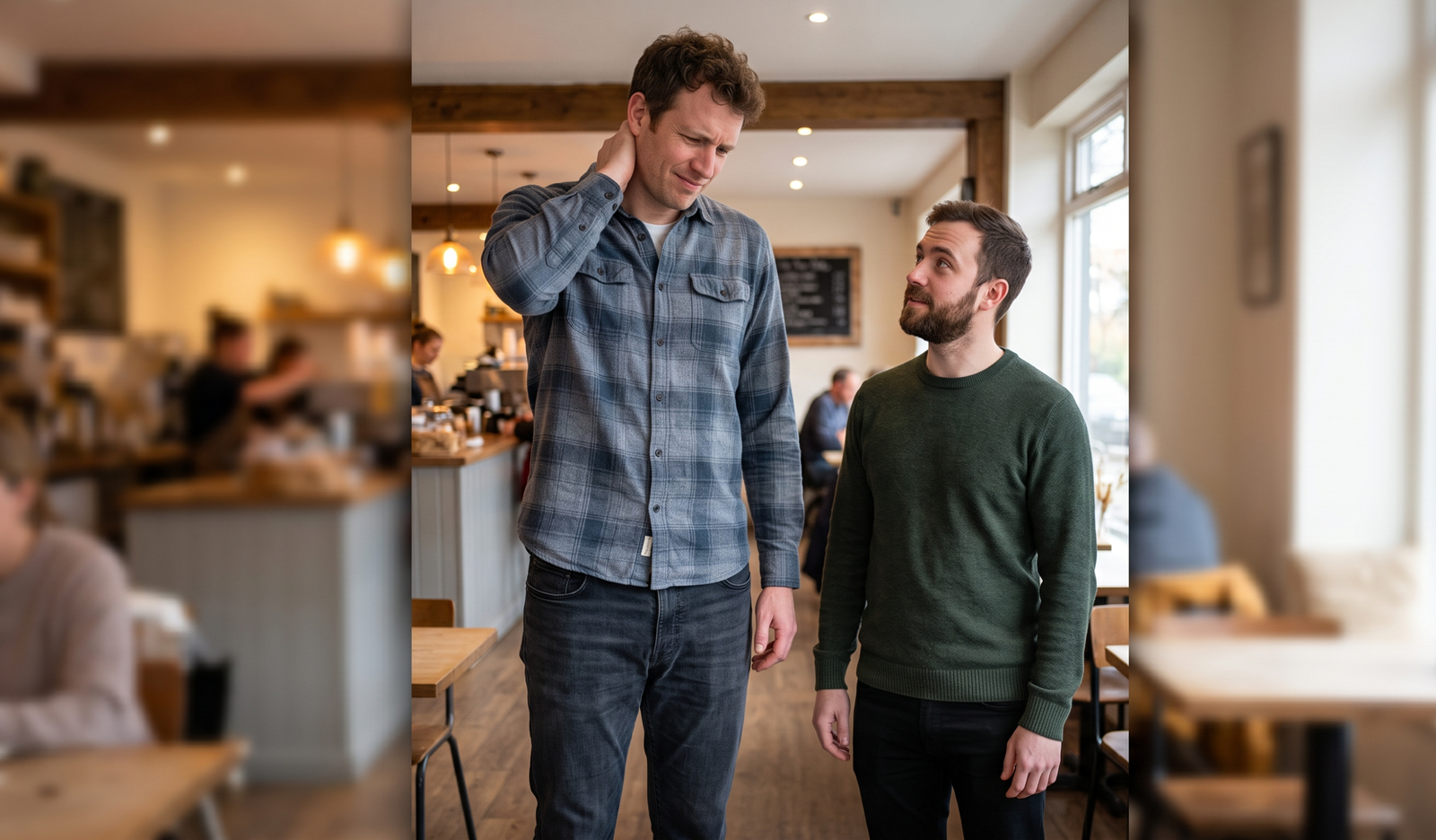
Walk into a café and the table has already been chosen.
Sit on an airplane and the seat dimensions are fixed.
Use a hotel bathroom and the sink isn’t going anywhere.
Work in an office and the desk may have been purchased years before anyone knew you would sit there.
For someone around average height, those dimensions may feel perfectly comfortable.
For someone considerably taller, they may require repeated adaptations.
You lean forward slightly more.
You lower your head toward the screen.
You spread your legs under a desk because there isn’t enough room.
You bend further toward a kitchen counter.
You adjust yourself to the chair rather than the chair adjusting to you.
None of those positions is inherently dangerous.
The human body is designed to bend, flex and adapt.
The question is:
How often are you being asked to adapt—and for how long?
The World Can Feel Surprisingly Low When You’re Tall
If you’re tall, you’ve probably experienced at least one of these.
The desk that’s slightly too low.
The bathroom mirror that somehow ends around your shoulders.
The kitchen counter that makes food preparation feel like a forward-bending exercise.
The airplane seat where your knees have nowhere to go.
The shower head that seems designed exclusively to wash your chest.
And, of course…
The laptop screen that’s somehow always below you.
One awkward interaction isn’t going to ruin your back.
But when your home, workplace, transport and everyday activities repeatedly require similar adaptations, the accumulated workload may become more relevant.
Why the Neck and Upper Back May Notice It First
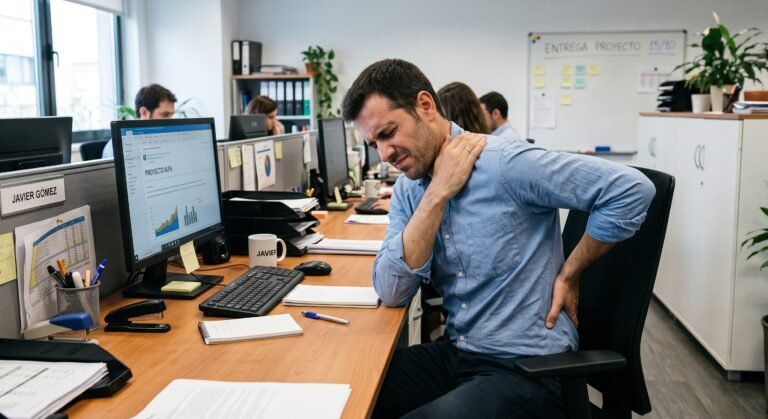
Imagine you’re working at a desk that’s too low for your proportions.
To interact comfortably with your computer, you may gradually bring your head and upper body toward the screen.
Your neck remains in that position.
Your shoulders may move forward.
Your upper-back muscles continue supporting the position while your hands work in front of you.
Again, none of these positions is inherently “bad.”
But holding relatively static positions for long periods can become tiring.
The issue may be less:
“Your posture is wrong.”
And more:
“Your workstation isn’t giving your body many comfortable options.”
That’s an important difference.
Because the solution isn’t necessarily teaching a tall person to sit perfectly upright all day.
It may be changing the environment so they don’t constantly have to adapt themselves to it.
Ergonomics Becomes More Important at the Extremes
Ergonomics is essentially about making the environment fit the person.
Not forcing the person to fit the environment.
And this becomes particularly interesting for people whose body dimensions fall further away from the average used when products and spaces are designed.
A chair may technically be adjustable.
But does the backrest reach the right place?
Can the seat accommodate longer thighs comfortably?
Does the desk rise high enough?
Can the monitor reach an appropriate height without stacking it on three books and an old shoebox?
Can your legs actually fit underneath?
Small mismatches can change how someone chooses to sit or work.
Research into computer workstations supports the broader idea that the relationship between workstation configuration, anthropometric fit and musculoskeletal symptoms exists—but is complex rather than explained by one measurement or posture alone.
That’s exactly why I don’t think the conversation should be:
“Tall people have bad backs.”
It should be:
“Does the environment you’re using actually fit your body?”
And This Brings Me Back to My Taller Clients
When a tall client tells me:
“My neck is always tight.”
I don’t immediately assume their height is the diagnosis.
Instead, I become curious about their day.
What do they do for work?
How high is their desk?
Do they use a laptop?
How much time do they spend sitting?
Do they travel frequently?
Do they train?
Are they constantly bending over work surfaces?
How are they sleeping?
Where exactly do they feel tension?
Because height may be part of the context.
But context isn’t the same thing as cause.
And sometimes, once you look at the person’s entire day, the reason their neck and upper back are working so hard becomes much easier to understand.
Do Tall People Actually Have “Bad Posture”?
Let’s get this one out of the way.
Being tall doesn’t automatically give you bad posture.
And having rounded shoulders or leaning forward occasionally doesn’t mean you’re damaging your spine.
The human body is designed to move through many different positions.
The interesting question isn’t:
“Do tall people sit badly?”
It’s:
“How often do tall people have to change their position because the environment doesn’t fit them?”
That’s a very different conversation.
If a screen is too low, you adapt.
If a table is too low, you adapt.
If your legs don’t comfortably fit underneath a desk, you adapt.
If the headrest in a car sits somewhere around your upper back, you adapt.
Your body becomes the adjustable part of an environment that isn’t adjustable enough.
And if that happens occasionally, it’s probably not particularly meaningful.
But when it happens for hours every day, the accumulated workload becomes much more interesting.
Tall People and Desk Work
Desk work is probably one of the clearest examples.
Imagine you’re considerably taller than average but using a standard office desk.
You adjust the chair upward so your legs feel comfortable.
Now your feet may no longer rest comfortably on the floor—or your relationship with the desk changes.
Lower the chair and your knees and hips may feel cramped.
Raise the desk and suddenly the monitor is still too low.
Use a laptop and things become even more complicated.
The keyboard and screen are physically attached to each other.
Position the keyboard comfortably for your hands and the screen may sit far below your natural eye level.
Raise the laptop toward your eyes and suddenly your arms have nowhere comfortable to work.
This isn’t exclusively a tall-person problem.
But longer limbs and a longer torso can make standardised furniture particularly interesting to negotiate.
The Laptop Problem Gets Bigger When You’re Tall
Laptops are wonderfully convenient.
Ergonomically?
They’re a compromise.
The screen and keyboard can’t independently adapt to your proportions.
For a taller person, that can mean spending long periods looking downward toward a screen while the hands remain positioned much lower.
Again:
Looking down isn’t inherently dangerous.
Your neck is perfectly capable of flexing.
The issue is spending hours with very little variation.
If you work extensively from a laptop, something as simple as raising the screen and using an external keyboard and mouse can sometimes make the setup considerably more adaptable.
The objective isn’t achieving an Instagram-perfect posture.
It’s giving your body more comfortable options.
When the Desk Is Too Low, the Shoulders May Join In
Height mismatch doesn’t only involve the neck.
The shoulders and upper back may also adapt.
If your working surface doesn’t suit your proportions, you may find yourself repeatedly leaning toward it or positioning your arms differently to complete tasks.
That can influence the workload around the:
Neck.
Shoulders.
Shoulder blades.
Upper back.
Forearms.
Even the lower back.
This is one reason someone may arrive complaining about one specific area—perhaps the neck—but describe a working day that involves the entire upper body adapting repeatedly.
The painful spot isn’t always the whole story.
It’s Not Just Office Workers
This is where the topic becomes much bigger than laptops.
Think about professions that require people to repeatedly work with surfaces at fixed heights.
Chefs preparing food at kitchen counters.
Hairdressers leaning toward clients.
Dentists working over patients.
Hospitality workers preparing tables and rooms.
Healthcare professionals treating patients.
Massage therapists working over treatment tables.
Mechanics.
Laboratory workers.
Retail employees.
For someone considerably taller than the environment was designed to accommodate, the same task may require more bending or reaching than it does for a shorter colleague.
That doesn’t mean height inevitably causes pain.
It means the physical demand of the same job can differ depending on the body performing it.
And that distinction matters.
The Kitchen Counter Test
Here’s a very simple example.
Think about chopping vegetables.
For someone whose elbows naturally sit at a comfortable height relative to the counter, the task may require very little adjustment.
Now imagine someone significantly taller using exactly the same surface.
They may naturally bend slightly more through the hips, trunk or neck to see and work comfortably.
Five minutes?
Probably irrelevant.
Preparing food for hours every day as part of your profession?
Now duration enters the equation.
Again, we’re not trying to identify a forbidden posture.
We’re looking at repeated exposure.
That’s a much more useful way to think about ergonomics.
Travelling While Tall Is an Ergonomic Adventure
And then there’s travel.
If you’re tall, you already know where this section is going.
Airplane seats.
Limited legroom is the obvious problem, but it isn’t the only one.
Headrests may not sit where you’d like them.
Tray tables can feel surprisingly low.
Sleeping comfortably becomes an engineering project.
Your knees may remain relatively flexed for hours.
And finding a position that allows your entire body to relax can be difficult.
Then you arrive at the hotel.
The desk may be low.
The chair may be small.
The bed may be short.
And yes…
The shower head is somehow still at shoulder height.
At some point, you begin to wonder whether the entire world was designed by somebody who was 1.70 metres tall.
Why Travel May Make Existing Tension More Noticeable
Travel combines several factors at once.
Prolonged sitting.
Limited movement.
Luggage.
Unfamiliar beds.
Different pillows.
Changes in sleep.
More walking than usual.
And environments you can’t customise.
For a taller traveller, the inability to adjust seats, tables and sleeping environments to their proportions may add another layer of discomfort.
This doesn’t mean tall people are destined to suffer every time they fly.
But it helps explain why someone who normally manages their environment well at home may suddenly notice much more neck or upper-back tension during a trip.
At home, your desk fits you.
Your chair fits you.
Your monitor is where you want it.
Then you travel and lose control over almost all of those variables.
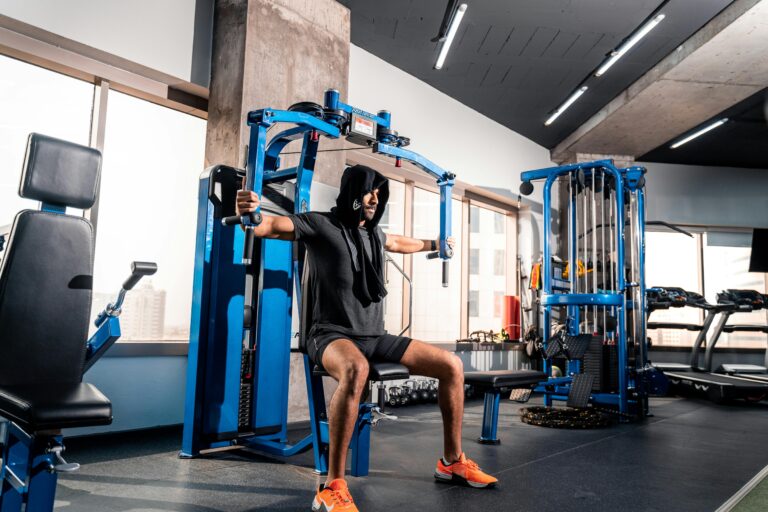
What About the Gym?
Here’s another interesting situation.
Tall people sometimes notice that certain exercises simply feel different.
And that’s hardly surprising.
Longer limbs change leverage.
A movement performed by someone with relatively short femurs and arms isn’t mechanically identical to the same movement performed by someone with considerably longer segments.
That doesn’t mean tall people shouldn’t lift weights.
Quite the opposite.
Strength training can be an excellent way to build physical capacity.
But exercise technique may need to accommodate individual anatomy rather than forcing everyone to look identical.
The goal isn’t:
“Make the tall person move like the shorter person.”
It’s:
“Find a movement strategy that works well for this person’s body.”
Individual variation matters.
In the gym just as much as at the desk.
Is Slouching Worse When You’re Tall?
Not automatically.
This is another myth I’d rather not reinforce.
Slouching isn’t a disease.
Your spine is allowed to flex.
And you don’t need to spend your life pulling your shoulders backwards because someone once told you to “stand up straight.”
What may matter more is how long you remain relatively still and whether you have enough variation throughout your day.
A tall person who slouches occasionally, exercises regularly, changes position frequently and feels completely comfortable doesn’t necessarily need their posture “corrected.”
Meanwhile, someone sitting beautifully upright for eight uninterrupted hours may still become uncomfortable.
Posture is a position—not a diagnosis.
The “Tall Person Hunch” May Sometimes Be an Adaptation
There’s also a social side to being tall that isn’t discussed very often.
Some taller people habitually lower themselves slightly when talking to shorter people.
They lean toward conversations.
They bend down to hear someone in a noisy environment.
They lower their head in photographs.
They adjust themselves to mirrors, doorways, screens and work surfaces.
Again, none of these behaviours is inherently problematic.
But they illustrate something important:
Tall people often spend their day adapting downward.
Not because their body is wrong.
Because much of their environment exists below their natural working height.
So Why Do So Many Tall Clients Tell Me Their Upper Back Feels Tight?
This brings me back to what originally made me curious about this topic.
I’ve had several taller clients come into my massage practice describing tension through the neck, shoulders and area between the shoulder blades.
My observation doesn’t prove that their height caused those symptoms.
But it does make me ask better questions.
Do you work at a laptop?
How high is your screen?
Do you spend your day leaning over people or equipment?
Do you travel frequently?
Does your chair actually fit your legs?
Can your desk accommodate your proportions?
Do you exercise?
How much movement do you get throughout the day?
And sometimes those questions reveal something much more useful than:
“Your back hurts because you’re tall.”
Perhaps the better explanation is:
Your body has spent years becoming incredibly good at adapting to environments that weren’t designed specifically for it.
And sometimes those adaptations become tiring.
The goal isn’t to change your height.
It’s to give your body fewer reasons to constantly compensate for it.
Okay, I’m Tall—What Can I Actually Do?
If you’ve made it this far, you may be thinking:
“Great. The world is too small for me. Now what?”
Fortunately, you don’t need to redesign every building you enter.
And you certainly don’t need to spend your life consciously pulling your shoulders backwards and trying to make yourself appear shorter.
The goal is much simpler.
Where you have control over your environment, make the environment work better for your body.
And where you don’t have control—on airplanes, in hotels, restaurants or temporary workspaces—give your body more opportunities to move and change position.
Start With the Environment You Use Most
You probably can’t change the height of the table at your favourite café.
But your own desk?
That’s worth looking at.
If you spend several hours there every day, small adjustments can make a meaningful difference to comfort.
Ask yourself:
Is my screen positioned somewhere I can comfortably see it?
Do my arms have enough space to work?
Can my legs fit underneath the desk without feeling cramped?
Does my chair actually accommodate the length of my thighs?
Can I change position easily?
Am I constantly leaning toward my workstation because everything feels slightly too low?
The objective isn’t creating one mathematically perfect posture.
It’s creating a workstation that gives your body more comfortable choices.
Raise the Screen—But Don’t Become Obsessed With It
For taller laptop users, raising the screen can be one of the simplest changes to experiment with.
A laptop stand combined with an external keyboard and mouse allows the screen and hands to be positioned independently.
That’s useful because your eyes and your hands don’t necessarily want to work at the same height.
But remember what we discussed in my guide to Tech Neck:
The goal isn’t to position your head perfectly and then freeze there for eight hours.
You should still move.
Lean back.
Stand.
Look down occasionally.
Change position.
Go for a walk.
A better workstation should give you freedom—not another posture you’re afraid to leave.
If You Can Adjust the Desk, Use That Advantage
For someone considerably taller than average, an adjustable desk can be particularly useful.
Not because standing is automatically healthier than sitting.
But because adjustability allows the environment to accommodate your proportions.
You can raise the working surface when standing.
Lower or modify it when sitting.
Change the relationship between your arms, screen and trunk.
And most importantly:
You have options.
Ergonomics works best when the environment adapts to the person.
Not when the person spends eight hours adapting to the furniture.
Don’t Replace Sitting All Day With Standing All Day
This deserves mentioning.
You buy a standing desk.
You raise it.
Problem solved?
Not quite.
Standing for eight hours without much movement is still eight hours spent in a relatively limited set of positions.
The advantage of a sit-stand workstation isn’t that standing is the magical “correct” posture.
It’s that you can alternate.
Sit.
Stand.
Walk.
Lean.
Move.
Then sit again.
Your body doesn’t need one perfect position.
It needs options.
Movement Is Particularly Valuable When You Can’t Change the Environment
Now imagine you’re travelling.
You can’t raise the airplane seat.
You can’t redesign the hotel desk.
And asking the restaurant to rebuild the table because you’re 1.94 metres tall probably isn’t going to go particularly well.
That’s where movement becomes especially useful.
Change position when possible.
Stand during longer journeys when it’s safe and practical.
Walk around periodically.
Move your shoulders.
Gently move your neck through comfortable ranges.
Stretch your legs.
Take breaks from the hotel laptop setup.
None of these actions “corrects” your height.
They simply reduce the amount of time your body spends adapting to one uncomfortable environment.
Strength Is Useful Too
If you’re tall and regularly experience upper-back or neck tension, you may be tempted to stretch constantly.
Stretching can feel wonderful.
But flexibility isn’t the only thing worth considering.
Strength and general physical capacity matter too.
Resistance training exposes your muscles to loads that are very different from sitting at a desk or leaning over a work surface.
Exercises involving the back, shoulders, arms and trunk can form part of a well-rounded training routine.
That doesn’t mean every tall person needs a special “posture correction programme.”
You don’t need to exercise because your height is a problem.
You exercise because a body that’s exposed to varied movement and appropriate physical load generally has more options than one that spends most of its week performing the same few tasks.
Stop Trying to Make Yourself Smaller
This one isn’t really an ergonomic adjustment.
It’s a habit worth noticing.
Some tall people become accustomed to slightly lowering themselves around other people.
You lean into conversations.
You bend toward someone who’s speaking.
You subtly round yourself in photographs.
You lower your head because the mirror is too low.
None of this needs to become another thing you’re worried about.
But if you catch yourself constantly adapting downward, simply notice it.
You don’t need to “correct” yourself every five seconds.
You also don’t need to spend your entire life apologising to the environment for being tall.
Sometimes the environment needs to come up to you.
Can Massage Help Tall People With Neck & Upper-Back Tension?
Now we arrive at the question I hear in a different form all the time.
If your neck, shoulders and upper back regularly feel tense, can massage help?
Potentially, yes.
But not because massage changes your height.
And not because I can permanently “correct” the posture your body has developed over the years.
Massage can provide targeted pressure, movement and sensory input to areas that feel tired, sensitive or tense.
For some people, that can temporarily reduce the sensation of muscular tension and make movement feel more comfortable.
It can also give muscles that have spent the day working an opportunity to experience something completely different.
But I think it’s important to be realistic:
Massage doesn’t make an unsuitable workstation suddenly fit you.
If you return to exactly the same physical demands afterwards, those demands still exist.
That’s why I prefer thinking of massage as one part of the bigger picture.
Where I May Focus During a Massage
When a taller client comes to me describing neck and upper-back tension, I don’t have a special “tall person massage.”
Nor should I.
Height gives me context.
The individual gives me the treatment plan.
Depending on what you tell me and how your body responds, I may spend more time around areas such as the:
- Neck.
- Upper shoulders.
- Upper and mid-back.
- Areas surrounding the shoulder blades.
- Base of the skull.
- Arms or forearms when relevant.
But I won’t assume those areas need deep pressure simply because you’re tall.
Some clients respond well to stronger therapeutic work.
Others feel much better with slower, moderate pressure.
And sometimes an area you expected to be extremely tense isn’t the one demanding the most attention that day.
That’s why assessment and communication matter more to me than height alone.
Deep Tissue Isn’t Automatically Better for a Bigger Body
This is another assumption worth challenging.
Tall person.
Big frame.
Therefore:
Maximum pressure.
Nope.
Body size doesn’t tell me how much pressure your nervous system enjoys.
A very tall, muscular client may be extremely sensitive to deep work.
A much smaller person may love considerable pressure.
And both are completely normal.
The appropriate intensity depends on the individual—not the dimensions of their skeleton.
Therapeutic massage should respond to your body.
It shouldn’t try to overpower it.
Massage Can Address the Symptoms—But Look at the Pattern
Suppose your upper back feels fantastic after massage.
Then three days later, the same tension returns.
That doesn’t necessarily mean you “need another massage.”
It may be worth becoming curious.
What happened during those three days?
Were you working ten-hour shifts?
Did you spend several hours on a laptop?
Did you travel?
Did you train unusually hard?
Did you sleep poorly?
Is your desk still far too low?
Massage can be valuable for managing symptoms and providing periods of comfort.
But recurring tension can also be information.
Sometimes your body is repeatedly responding to a demand that hasn’t changed.
And that’s where adjusting the environment, increasing movement, building physical capacity or seeking appropriate professional assessment may be more useful than simply applying more pressure to the same spot.
Being Tall Isn’t Something Your Body Needs to Recover From
This might be the most important section of the article.
Your height isn’t an injury.
It isn’t a dysfunction.
And it doesn’t need treatment.
If you’re tall and experience neck or upper-back tension, the goal isn’t to “fix” the body that grew that way.
The goal is to understand the demands being placed on it.
Maybe your workstation needs adjusting.
Maybe you need more movement throughout the day.
Maybe your training could include more varied physical loading.
Maybe travelling has temporarily increased your discomfort.
Maybe massage helps you feel better during particularly demanding periods.
Or perhaps your symptoms have nothing meaningful to do with your height at all.
That’s why the question:
“Does my back hurt because I’m tall?”
may not be the most useful one.
A better question could be:
“What is my body being asked to do every day—and does my environment make that harder than it needs to be?”
That’s a question we can actually do something about.
Massage for Tall Clients in Barcelona
Being tall isn’t something I treat.
You are not the problem.
What I can work with are the symptoms and physical demands you’re experiencing.
Perhaps your neck feels tired after spending the week looking down toward a laptop.
Maybe your upper back feels tense after working over surfaces that never seem quite high enough.
Perhaps you’ve just arrived in Barcelona after several hours folded into an airplane seat designed for someone considerably smaller.
Or maybe you’re tall, your neck hurts…
and the two things have absolutely nothing to do with each other.
That’s why I don’t want to make assumptions based on height alone.
I want to understand your body, your routine and what you’re feeling today.
A Personalised Approach Matters More Than Your Height
If you visit me for a Therapeutic Massage in Barcelona, we’ll first talk about what’s actually bothering you.
Where do you feel tension?
When do you notice it?
What do you do for work?
Do you spend long periods sitting?
Do you train regularly?
Have you been travelling?
Does movement help?
Does anything make the discomfort noticeably worse?
Those questions tell me far more than simply knowing you’re 1.90 metres tall.
From there, I can adapt the session according to what your body needs.
That may involve focused work around the neck and shoulders.
It may include the upper or mid-back.
Sometimes the areas surrounding the shoulder blades deserve more attention.
And sometimes we discover that the place you expected me to work isn’t actually the area that feels most sensitive.
That’s why I prefer personalised treatment over a predetermined massage routine.
Private Massage in Eixample for Neck & Upper-Back Tension
If you’re experiencing neck, shoulder or upper-back tension while living in or visiting Barcelona, I’d be happy to welcome you to my private massage studio in Eixample.
My sessions are personalised according to your symptoms, preferences and how your body responds during treatment.
Depending on your needs, I may incorporate elements of Therapeutic Massage, Deep Tissue Massage, mobility and slower relaxation techniques.
The objective isn’t to straighten you.
Shrink you.
Or convince you that your posture is wrong.
It’s simply to help areas that feel overloaded become more comfortable while considering the bigger picture behind your symptoms.
Because sometimes the most useful question isn’t:
“What’s wrong with my back?”
It’s:
“What has my back been dealing with lately?”
Frequently Asked Questions
Do tall people have more back pain?
Not necessarily.
Being tall doesn’t automatically mean you’ll experience more back pain.
Musculoskeletal pain is influenced by many factors including physical workload, activity, sleep, stress, previous injuries, general health and the environments you use.
Height may become relevant when furniture, equipment or workspaces don’t comfortably accommodate your body dimensions, but it shouldn’t automatically be considered the cause of pain. Research examining workstation fit similarly suggests that musculoskeletal symptoms arise from multiple interacting factors rather than a simple body-measurement-to-pain relationship.
Do tall people experience more neck pain?
There isn’t strong evidence that being tall alone inevitably causes neck pain.
However, taller people may encounter workstations, screens or other environments that require them to adapt their position more frequently.
Long periods of relatively static or demanding positioning may contribute to discomfort in some people, but neck pain remains multifactorial.
Why do tall people sometimes slouch?
There can be many reasons.
A tall person may lean forward to use a low screen, work surface or table, communicate with shorter people or simply because that position feels comfortable.
Slouching itself shouldn’t automatically be interpreted as dysfunction.
Posture is a position—not a diagnosis.
Does being tall cause bad posture?
No.
There isn’t one universally perfect posture, and taller bodies shouldn’t be judged against an arbitrary visual ideal.
A more useful question is whether your working and living environments give you comfortable options and enough opportunities to move.
Can a desk that’s too low cause upper-back tension?
A workstation that doesn’t fit your body may influence the positions you use while working and potentially contribute to discomfort.
Research into workstation configuration supports considering the relationship between anthropometry, posture and symptoms rather than applying exactly the same setup to everyone.
Should tall people use standing desks?
A height-adjustable desk can be useful because it provides more options and may accommodate individual proportions better.
However, standing all day isn’t automatically superior to sitting all day.
The advantage is being able to alternate positions rather than replacing one prolonged posture with another.
Can massage help upper-back and neck tension in tall people?
Massage may help some people temporarily feel more comfortable and reduce their perception of muscular tension.
However, massage doesn’t change height or permanently correct posture.
If an unsuitable workstation or repetitive physical demand is contributing to your symptoms, addressing that bigger picture may also be useful.
Is Deep Tissue Massage better for tall people?
No.
Height and body size don’t determine the appropriate massage pressure.
Some tall or muscular clients enjoy deep pressure; others are highly sensitive to it.
I adapt pressure according to the individual rather than assuming that a larger body needs a stronger massage.
When should neck or back pain be medically assessed?
Seek appropriate medical assessment for severe or progressively worsening pain, significant trauma, pronounced weakness, persistent numbness or tingling, coordination problems, fever or other unusual neurological or systemic symptoms.
Persistent pain that repeatedly interferes with your daily activities also deserves proper assessment rather than simply being blamed on your height.
Continue Reading
If this article helped you understand your neck and back a little better, you may also enjoy:
- Can Massage Help With Tech Neck? A Physiotherapy-Informed Guide
- What Happens to Your Body During a 60-Minute Massage?
- Deep Tissue vs Therapeutic Massage: Which One Is Right for You?
- Does Massage Really Help Back Pain?
- Is It Normal to Feel Sore After a Massage?
- Why Your Neck Hurts After a Long Flight
These articles explore massage, pain and recovery without relying on fear-based posture advice or wellness myths.
About the Author
Hi, I’m Lina.
I’m a massage therapist with a background in Physiotherapy, and I specialise in therapeutic massage and helping people experiencing muscular tension, particularly around the back, neck and shoulders.
Working with clients from different professions, lifestyles and body types has taught me something important:
Bodies aren’t standardised.
That’s why I believe massage shouldn’t be standardised either.
Through this blog, I combine my practical experience with evidence-informed information to help you better understand your body and make informed decisions about massage, movement and recovery.

Massage for Neck and Shoulder Pain in Barcelona: Which Massage Should You Choose?

Massage for Back Pain in Barcelona: Which Treatment Should You Choose?

Why Does My Back Hurt More When I’m Stressed?
Why Do I Have Knots in My Back? And Can Massage Actually Get Rid of Them?
Do Tall People Have More Neck & Back Pain?