
Why Does My Back Hurt More When I’m Stressed?
A Physiotherapy-Informed Guide to Stress, Muscle Tension and Pain
You haven’t lifted anything particularly heavy.
You didn’t injure your back.
You haven’t suddenly changed your workout.
But somehow, during the most stressful week you’ve had in months…
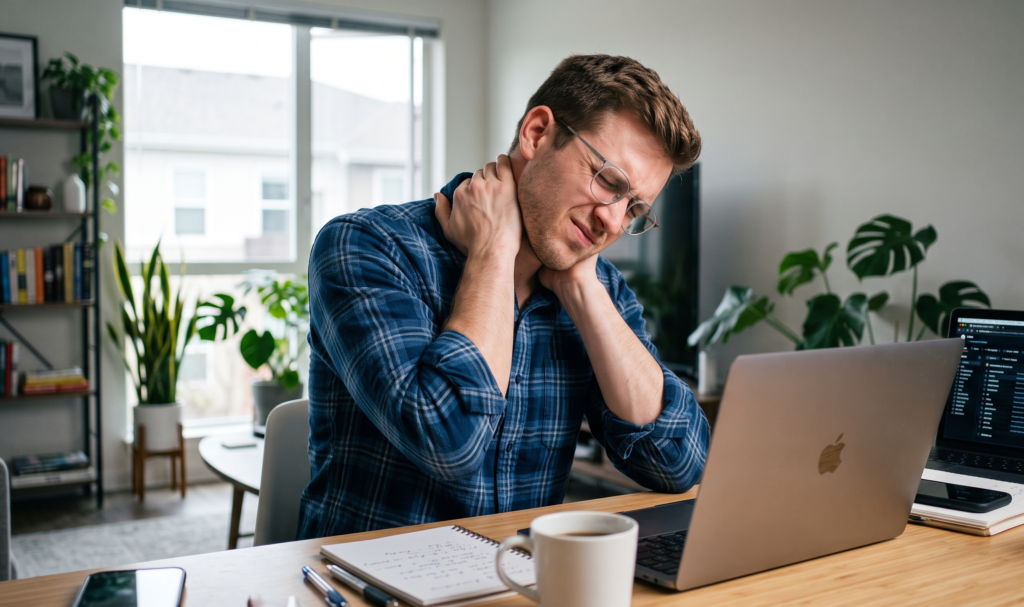
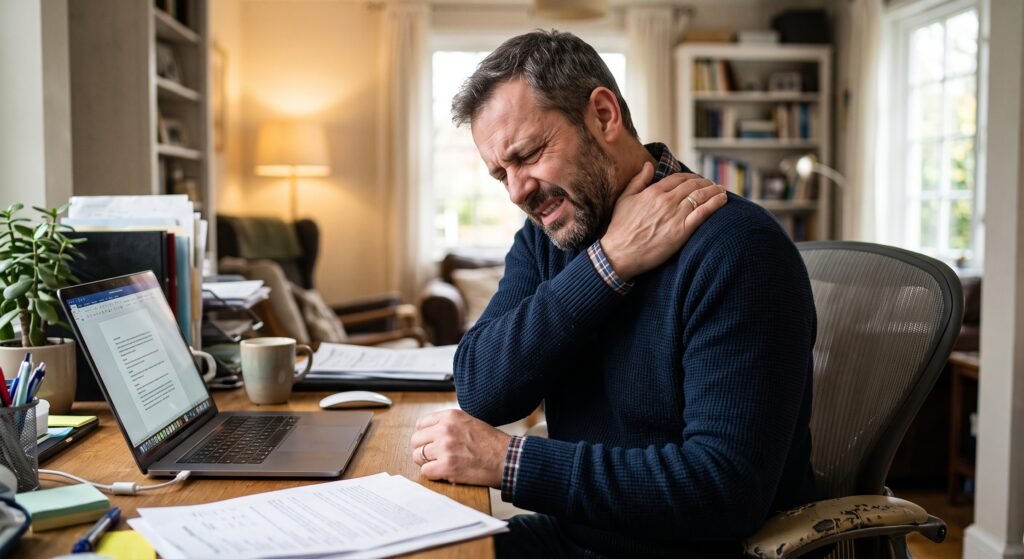
Your shoulders feel tense.
Your neck feels stiff.
That familiar spot between your shoulder blades is back.
And now your lower back has apparently decided:
“This meeting could have been an email, and I’d like to formally complain too.”
It can seem strange.
Stress happens in your mind.
Back pain happens in your body.
Right?
Not quite.
The brain, nervous system and musculoskeletal system aren’t separate departments that refuse to speak to each other.
Your emotional state can influence sleep, movement, muscle activity, behaviour and how your nervous system processes potentially uncomfortable sensations.
So yes:
Stress can influence how your back feels.
But that statement needs an important clarification.
It does not mean:
“Your pain is imaginary.”
And it certainly doesn’t mean:
“It’s all in your head.”
The relationship between stress and pain is considerably more interesting than that.
Pain is a real experience influenced by many factors.
Physical workload matters.
Injury can matter.
Sleep matters.
Movement matters.
Previous experiences matter.
General health matters.
And psychological and social factors—including stress—can matter too.
This doesn’t make pain less physical or less real.
It simply means the human body is more complicated than:
Something hurts = something must be damaged.
Sometimes understanding the context surrounding pain is just as important as understanding where it hurts.
In This Guide
- Can stress really cause back pain?
- Why stress can make existing pain feel worse.
- What your nervous system has to do with pain.
- Why your shoulders tense when you’re stressed.
- How stress and sleep interact.
- Why stressful weeks can bring back familiar “muscle knots.”
- The relationship between jaw clenching, neck tension and stress.
- Whether massage can help with stress-related muscle tension.
- What you can do when your body feels worse during stressful periods.
- When back pain needs medical assessment rather than being blamed on stress.
First: Can Stress Actually Cause Back Pain?
This question sounds simple.
The answer isn’t.
Stress can influence musculoskeletal pain, but I wouldn’t reduce someone’s back pain to:
“You’re stressed. That’s why.”
Back pain is multifactorial.
There may be physical demands involved.
Work.
Training.
Prolonged positions.
Previous injuries.
Health conditions.
Sleep.
Activity levels.
And many other factors.
Stress can become another part of that picture.
For some people, symptoms become noticeably worse during emotionally demanding periods.
Others may notice an old painful area suddenly becoming more sensitive.
And some people don’t notice any relationship at all.
That’s normal too.
There isn’t one universal stress response.
Your Pain Is Real—Even When Stress Influences It
This deserves its own section because people with persistent pain hear frustrating things.
“It’s just stress.”
“You need to relax.”
“You’re probably thinking about it too much.”
Those statements aren’t particularly helpful.
If your back hurts, the pain you’re experiencing is real.
Psychological factors influencing pain does not make pain psychological or imaginary.
Think about something simpler.
You’re exhausted after sleeping four hours.
Does that mean your tiredness is imaginary because sleep influenced it?
Of course not.
Your physical experience changes according to the state of the entire organism.
Pain can too.
Your Nervous System Is Always Paying Attention
Your nervous system has an enormous job.
It receives information from throughout your body and environment and continuously decides what deserves your attention.
Most of this happens without conscious thought.
When life feels safe and manageable, certain sensations may barely register.
During periods of high stress, poor sleep or emotional strain, the same sensations can sometimes become much harder to ignore.
This doesn’t necessarily mean the tissue suddenly became more damaged.
It may mean the volume has changed.
I like that analogy.
Imagine your body constantly producing information.
Movement.
Pressure.
Temperature.
Fatigue.
Muscular effort.
Usually, the nervous system manages that information without you thinking much about it.
But sometimes the volume knob gets turned upward.
A sensation that was background noise yesterday becomes considerably louder today.
The sensation is real.
The volume changed.
Stress Doesn’t Live Only in Your Thoughts
Think about the last time you were seriously stressed.
What happened physically?
Maybe your heart rate increased.
Your breathing changed.
Your stomach felt different.
Your hands became sweaty.
You clenched your jaw.
Your shoulders moved upward.
You couldn’t sleep.
You felt restless.
None of those responses is imaginary.
They’re physical responses occurring within the body.
So the idea that stress could also influence muscular tension or pain shouldn’t be particularly surprising.
Mind and body aren’t separate systems.
They’re different ways of describing the same human being.
Why Do My Shoulders Tense When I’m Stressed?
This is something I see frequently.
Someone lies down for massage.
I begin working around the shoulders.
And they say:
“I didn’t realise how tense I was.”
Sometimes we’re carrying muscular activity without consciously noticing it.
During concentration or stress, some people subtly elevate their shoulders.
Others hold their breath.
Some clench their hands.
Many clench their jaw.
Do that for ten seconds?
Probably not particularly interesting.
Repeat it throughout a demanding eight-hour working day?
Now the accumulated workload may become more noticeable.
And suddenly by 7 p.m. your shoulders have moved into a postcode somewhere near your ears.
Stress Can Also Change How You Move
Here’s another part people often overlook.
When you’re stressed, your behaviour may change.
Maybe you stop exercising because work becomes overwhelming.
You sit for longer.
You skip your lunchtime walk.
You spend more time scrolling.
You work later.
You eat differently.
You sleep less.
You spend the weekend recovering on the sofa rather than doing the activities you normally enjoy.
None of these behaviours is inherently wrong.
Sometimes life simply gets busy.
But collectively, they change the physical environment your body is experiencing.
So when someone says:
“My back always hurts when work gets stressful,”
the explanation may not be one single stress hormone attacking their trapezius.
The stressful period may have changed multiple things simultaneously.
And Then There’s Sleep
This is where the relationship becomes particularly important.
Stress can interfere with sleep.
And poor sleep can influence pain sensitivity, mood, recovery and energy.
Then pain itself can make sleeping more difficult.
Which can create an annoying little loop:
Stress → poorer sleep → increased sensitivity → more noticeable pain → poorer sleep.
That doesn’t mean every person with back pain needs to sleep more and everything will disappear.
If only healthcare were that easy.
But it does mean sleep deserves attention when symptoms suddenly become worse during stressful periods.
Sometimes the question isn’t only:
“What did I do to my back?”
It might also be:
“How have I been sleeping lately?”
Why That Old Muscle Knot Suddenly Comes Back
Remember our famous spot between the shoulder blade and spine?
The one we discussed in Why Do I Have Knots in My Back?
You haven’t noticed it for weeks.
Then comes:
Deadline.
Poor sleep.
Longer working hours.
Less exercise.
More laptop time.
And one afternoon…
“Oh. You again.”
The natural reaction is to assume the knot physically returned.
But perhaps the area simply became more noticeable again because several parts of your routine changed simultaneously.
This is why recurring tension deserves context.
Not panic.
Stress May Reveal Your Familiar Areas
Something I find particularly interesting is that people often have their own recurring locations.
For one person:
Neck.
For another:
Lower back.
Another:
Shoulders.
Another:
Jaw.
And when life becomes particularly demanding, those familiar areas sometimes become louder.
I don’t interpret that as evidence that stress has physically damaged the muscle.
Instead, it makes me curious.
What changed this week?
How much have you been working?
How have you been sleeping?
Have you been moving?
Are you training?
Are you clenching your jaw?
Has anything else changed?
Because your symptoms don’t happen outside your life.
Your life is part of the clinical picture.
But Be Careful With the Stress Explanation
There’s an important danger here.
Once somebody learns that stress can influence pain, it becomes tempting to explain everything with stress.
Neck hurts?
Stress.
Back hurts?
Stress.
Headache?
Stress.
Leg fell off?
Probably stress.
No.
Stress is one possible contributor.
It shouldn’t become a convenient explanation that prevents proper assessment when symptoms need it.
Pain can have many causes and contributors.
And new, severe, unusual or progressively worsening symptoms deserve appropriate attention.
We can acknowledge the relationship between stress and pain without blaming every physical symptom on someone’s emotional state.
That’s the balance I’m interested in.
The Better Question
Instead of asking:
“Is my back pain physical or stress-related?”
I prefer:
“What factors might be influencing how my back feels right now?”
Maybe physical workload is a major part.
Maybe poor sleep is contributing.
Perhaps stress has been unusually high.
Maybe you’ve stopped exercising.
Maybe your workstation isn’t particularly comfortable.
Perhaps several things are happening together.
Human bodies rarely give us the convenience of one perfect explanation.
And that’s exactly why treating the person usually makes more sense than chasing one isolated symptom.
So Where Does Massage Fit Into This?
This is where we need to be precise.
Massage cannot remove stress from your life.
I cannot massage away your deadline.
I cannot negotiate with your boss.
I cannot answer your emails.
And unfortunately…
I cannot make the person who scheduled a 7:30 a.m. Monday meeting reconsider their life choices.
What massage can provide is something different.
Time away from those demands.
Touch.
Movement.
Pressure.
A quieter environment.
An opportunity to notice how your body feels.
And for some people, a temporary reduction in muscular tension or discomfort.
But understanding why that may feel so powerful during stressful periods requires us to look at something bigger than muscles alone.
We need to talk about the nervous system.
Your Nervous System: The Volume Control of Pain
When people hear “nervous system,” they often imagine something complicated.
Brain.
Spinal cord.
Nerves.
Electrical signals.
Diagrams from biology class that nobody particularly enjoyed.
But for our purposes, we can make it much simpler.
Your nervous system is constantly receiving information.
From your muscles.
Your joints.
Your skin.
Your organs.
Your eyes.
Your ears.
And the environment around you.
Then your brain has to interpret that enormous amount of information and decide:
What matters right now?
Most sensations never become particularly important.
Your shirt touching your back.
The pressure of the chair underneath you.
Your feet inside your shoes.
You probably weren’t thinking about any of those things until I mentioned them.
Sorry.
Now you can feel all three.
That’s attention.
And attention is one of many things that can influence how strongly we experience sensations.
Pain Isn’t a Direct Damage Meter
This is one of the most important ideas in modern pain science.
Pain is extremely useful.
It protects us.
It encourages us to change behaviour when the body believes something may require attention.
But pain isn’t a perfect measurement of tissue damage.
More pain doesn’t always mean more damage.
And less pain doesn’t always mean everything is structurally perfect.
Think about a paper cut.
Tiny injury.
Absolutely unreasonable amount of drama.
Then consider how people sometimes discover bruises without remembering how they got them.
More tissue change.
Almost no pain.
The relationship isn’t one-to-one.
Pain is an experience produced when the nervous system interprets available information as sufficiently important or threatening to require your attention.
That information includes what’s happening in the tissues.
But it also exists within a much larger context.
Context Can Change Pain
Here’s a simple example.
Imagine your lower back feels slightly uncomfortable.
Scenario one:
You’re on holiday.
You’ve slept beautifully.
You’re walking beside the Mediterranean.
You notice your back for a moment.
Then someone says:
“Do you want ice cream?”
Your attention moves elsewhere.
Excellent medical intervention.
Now imagine the same sensation during:
A stressful deadline.
Four hours of sleep.
An argument.
Eight hours behind a laptop.
And the thought:
“Oh no. Is my back getting worse again?”
The sensation may suddenly feel considerably more important.
Same person.
Similar physical sensation.
Very different context.
This doesn’t mean the second experience is imaginary.
It means context matters to the nervous system.
Stress Can Turn Up the Volume
Remember our volume-control analogy from Part 1?
Stress can sometimes make the nervous system more alert.
That’s useful.
If something genuinely threatening is happening, you want a system capable of responding quickly.
The problem is that modern stress doesn’t always look like a tiger chasing you.
Sometimes the tiger is:
37 unread emails.
A deadline.
Money worries.
Relationship problems.
A delayed flight.
A difficult client.
Three WhatsApp messages beginning with:
“Hey, quick question…”
Your nervous system doesn’t necessarily respond to every stressor identically.
But during sustained stressful periods, some people notice that their bodies become more sensitive.
Existing aches feel louder.
Muscles feel more tense.
Headaches appear.
Sleep becomes worse.
And familiar painful areas become harder to ignore.
This Does NOT Mean “Your Brain Is Inventing Pain”
I want to repeat this because it’s so important.
Saying the nervous system participates in pain does not mean:
“Your brain made it up.”
All pain involves the nervous system.
Stub your toe?
Nervous system.
Burn your hand?
Nervous system.
Sprain your ankle?
Nervous system.
Persistent lower-back pain?
Also nervous system.
Without your nervous system processing information, you wouldn’t experience pain at all.
So acknowledging the brain’s role doesn’t make pain less physical.
Your brain is part of your body.
We occasionally forget that.
Why Can the Same Activity Hurt One Day and Not Another?
This is something people with recurring back or neck discomfort often notice.
Monday:
Eight hours at your desk.
Fine.
Tuesday:
Same desk.
Same chair.
Same laptop.
By 4 p.m…
“Why is my neck killing me?”
It’s tempting to assume you must have sat incorrectly.
But maybe Tuesday wasn’t actually identical.
Perhaps you slept poorly.
You trained hard the evening before.
You’re worried about something.
You’ve barely moved all day.
You’ve skipped lunch.
Your workload is higher.
Your familiar shoulder area was already slightly sensitive.
Your body isn’t experiencing “eight hours of sitting” in isolation.
It’s experiencing eight hours of sitting inside everything else happening in your life.
That’s why symptoms can fluctuate even when the activity appears identical.
Stress and Muscle Tension: Are Your Muscles Actually Tighter?
Sometimes, yes.
People can increase muscular activity when they’re concentrating, anticipating something or feeling stressed.
Think about what happens when you’re nervous.
Jaw clenched.
Shoulders elevated.
Hands tight.
Breathing changed.
But there’s another important distinction:
Feeling tight doesn’t always mean a muscle is objectively shortened or permanently contracted.
“Tightness” is a sensation.
And sensations can be influenced by many things.
This is similar to what we discussed with muscle knots.
An area can genuinely feel incredibly tight without there necessarily being a physical knot or shortened muscle that needs to be mechanically stretched back into shape.
The Jaw–Neck–Shoulder Connection
Here’s something worth observing during your next stressful day.
Check your jaw.
Are your teeth touching?
Are you clenching?
Now check your shoulders.
Have they moved upward?
Check your hands.
Are you gripping the mouse harder than necessary?
And finally:
Are you breathing comfortably?
You don’t need to monitor yourself obsessively.
Please don’t spend tomorrow conducting a full biomechanical inspection every seven minutes.
But occasional awareness can reveal habits you didn’t realise were happening.
For some people, simply noticing:
“Wow, I’ve been clenching my jaw for an hour.”
is useful information.
What About Breathing?
Stress can change breathing patterns too.
Some people breathe faster.
Others take shallower breaths.
Some hold their breath while concentrating.
Your breathing involves muscles around the rib cage, trunk and neck.
That doesn’t mean every neck problem is secretly a breathing dysfunction.
Please don’t let Instagram do that to you.
But if you spend an entire stressful day breathing differently, clenching your jaw and holding your shoulders rigidly while staring at a laptop…
It’s not surprising if your upper body feels different by evening.
Again:
Not damage.
Demand.
Why Does Massage Feel So Good When I’m Stressed?
Now things start connecting.
During massage, several things change simultaneously.
You’re no longer working.
You’re usually not looking at a screen.
You aren’t answering messages.
You’re lying down.
The environment is quieter.
You’re receiving touch and pressure.
You’re moving from one context into another.
For an hour, your nervous system is receiving a very different set of signals.
And for some people, that can feel enormously relieving.
Not because massage has physically extracted stress from the trapezius.
Stress isn’t hiding in there waiting for me.
I’ve looked.
But the context has changed.
And changing context can influence how your body feels.
Massage Is More Than Pressure on Muscles
This is why I don’t think massage should be understood purely mechanically.
The old explanation is tempting:
Muscle tight.
Massage pushes muscle.
Muscle becomes loose.
Done.
But massage involves far more.
Touch.
Temperature.
Pressure.
Movement.
Attention.
Expectation.
Safety.
Relaxation.
Human interaction.
And sensory input to the nervous system.
All of those things exist simultaneously during the treatment.
That doesn’t make massage mystical.
It makes it human.
Does Massage Activate the Parasympathetic Nervous System?
You’ll see this claim everywhere:
“Massage activates the parasympathetic nervous system.”
There’s some physiological research showing massage can be associated with changes in measures related to autonomic activity and relaxation.
But I wouldn’t reduce the experience to:
Massage → parasympathetic switch ON → stress OFF.
The autonomic nervous system isn’t a light switch.
And humans aren’t machines with a hidden RELAX button underneath the shoulder blade.
Although that would make my job considerably easier.
It’s more accurate to say that massage can create conditions that some people experience as calming and relaxing.
How strongly someone responds varies.
Why Some People Almost Fall Asleep During Massage
You’ve probably experienced that strange moment.
You’re awake.
Then you’re not quite awake.
Then you suddenly realise you may have been asleep.
Then you wonder:
“Did I snore?”
Relaxation, reduced external demands, lying comfortably and repetitive sensory input can make some people extremely sleepy.
And yes…
Sometimes clients snore.
It’s fine.
I consider it positive feedback.
Other clients remain completely awake and talk throughout the session.
That’s fine too.
There isn’t one correct nervous-system response to massage.
And Why Some People Don’t Relax at All
This matters just as much.
Not everyone automatically relaxes when receiving massage.
Perhaps it’s their first session.
Maybe they’re uncomfortable being touched.
They’re worried about pressure.
They have difficulty switching off.
Their mind is still at work.
Or they simply don’t enjoy massage very much.
That’s allowed.
A person doesn’t fail massage because they didn’t fall asleep.
And telling someone:
“Just relax.”
is approximately as effective as telling someone who’s angry:
“Calm down.”
Relaxation isn’t something we can force.
We create an environment where it may happen.
Why One Massage Can’t Remove Chronic Stress
Here’s where realistic expectations matter.
Imagine someone is working 70 hours per week.
Sleeping five hours.
Dealing with significant personal stress.
Barely moving.
Constantly connected to their phone.
Then they receive a one-hour massage.
Can that hour feel wonderful?
Absolutely.
Can it temporarily change how their body feels?
Potentially.
Can it erase everything happening during the other 167 hours of the week?
No.
Massage can be part of stress management.
It shouldn’t carry responsibility for your entire life.
That’s far too much pressure for one massage table.
Temporary Relief Still Matters
But don’t make the opposite mistake either.
Something doesn’t need to permanently solve a problem to have value.
A walk doesn’t permanently eliminate stress.
A good night’s sleep doesn’t guarantee you’ll never be tired again.
Exercise doesn’t make you permanently fit after one session.
And massage doesn’t need to permanently eliminate muscular tension to be worthwhile.
If an hour helps you feel more comfortable, move differently, relax or simply disconnect from a demanding week…
That experience has value.
The key is understanding what massage can realistically offer.
What If My Back Feels Better Immediately After Massage?
Great.
Enjoy it.
We don’t need to overanalyse every positive response.
Perhaps the area feels less sensitive.
Maybe movement feels easier.
Maybe you simply feel calmer.
Maybe your shoulders feel lighter.
Several things may have contributed simultaneously.
What matters is that we don’t turn the improvement into an unsupported explanation such as:
“The therapist removed the stress toxins.”
Or:
“My vertebra was put back into place.”
Or:
“The knot has been permanently destroyed.”
Your body can feel better without anything needing to be broken, flushed or repositioned.
That’s actually a much nicer way to think about it.
But What Happens When the Stress Comes Back?
And now we reach the uncomfortable part.
Monday arrives.
The emails return.
The deadline still exists.
Your sleep isn’t perfect.
Your shoulders begin creeping upward again.
And that familiar back tension slowly reappears.
Does that mean you need another massage immediately?
Not necessarily.
This is where we need to move beyond the treatment room.
Because if stress can influence how your body feels…
The next question becomes:
What can you actually do about it?
And thankfully, the answer isn’t:
“Just relax.”
Because if that worked…
Nobody would be stressed.
What Can You Actually Do When Stress Makes Your Back Feel Worse?
Here’s the slightly inconvenient truth:
You probably can’t eliminate stress from your life.
Work will still exist.
Bills will continue arriving with impressive consistency.
Flights will still be delayed.
People will continue scheduling meetings that could absolutely have been emails.
So the goal isn’t:
“How do I create a completely stress-free life?”
That’s probably unrealistic.
A better question is:
“How can I support my body during periods when life becomes more demanding?”
That gives us considerably more options.
First: Don’t Panic Because Your Pain Increased
If you already experience recurring back or neck discomfort, a temporary increase during a stressful period can feel worrying.
You may immediately think:
“I’ve damaged something again.”
But fluctuations in pain don’t automatically mean new tissue damage has occurred.
Remember what we’ve discussed:
Pain is influenced by context.
Sleep.
Workload.
Stress.
Activity.
Previous sensitivity.
Health.
Expectations.
And many other factors.
If several of those variables change simultaneously, your symptoms may change too.
That doesn’t mean you should ignore new or concerning pain.
But it also doesn’t mean every flare-up represents a new injury.
Sometimes the body is having a difficult week because…
you are having a difficult week.
Keep Moving—Without Turning Movement Into Medicine
When your back feels uncomfortable, there’s a natural temptation to become very careful.
You stop bending.
You stop exercising.
You avoid movements because you’re worried they’ll make things worse.
For some conditions, temporary modification may absolutely be appropriate.
But for ordinary muscular tension and many episodes of uncomplicated back discomfort, completely avoiding movement isn’t necessarily helpful.
Walk.
Change position.
Move your shoulders.
Rotate your trunk comfortably.
Continue normal activities where appropriate.
Exercise if it feels reasonable.
The goal isn’t to perform a magical “stress back pain stretch.”
It’s simply to keep giving your body varied movement.
You Don’t Need Perfect Posture
Stressful week?
Back hurts?
Laptop involved?
Here comes the internet:
FIX YOUR POSTURE.
Posture can influence comfort, and an uncomfortable workstation may deserve adjustment.
But there isn’t one perfect position that protects you from pain.
You can sit upright.
Slouch.
Lean back.
Stand.
Cross your legs.
Move around.
The bigger issue for many people may be spending too long in any one position.
As I explained in Can Massage Help With Tech Neck?, variety is often more useful than trying to hold yourself perfectly upright all day.
Your spine isn’t auditioning for a posture competition.
Let it move.
Make Your Workspace Work for You
Although perfect posture isn’t required, your environment still matters.
If your screen is constantly forcing you into a position you dislike…
Change it if you can.
If your chair is uncomfortable…
Adjust it.
If you’re tall and your desk feels designed for a twelve-year-old…
We have already discussed this problem.
Small ergonomic changes can make work feel easier.
Raise the laptop if appropriate.
Use an external keyboard.
Adjust your chair.
Give your legs enough space.
Move frequently.
Work standing occasionally if you enjoy it.
Ergonomics isn’t about forcing your body into one perfect posture.
It’s about giving your body more comfortable options.
Take Movement Breaks Before Your Body Starts Shouting
A lot of people wait until their shoulders are furious before moving.
Three hours pass.
Then four.
Then suddenly:
“Why does my neck hurt?”
Instead of waiting for discomfort to remind you, occasionally interrupt long periods of inactivity.
Stand while taking a call.
Walk to get water.
Move your shoulders.
Look away from the screen.
Take a short walk.
None of these needs to become a complicated exercise programme.
Sometimes thirty seconds of movement is simply thirty seconds in which your body isn’t doing exactly the same thing.
That’s useful.
Exercise Can Help—but Don’t Use It as Punishment
Exercise has enormous benefits for physical and mental health.
Walking.
Strength training.
Cycling.
Swimming.
Boxing.
Yoga.
Dancing.
Whatever you genuinely enjoy.
But I don’t want you thinking:
“My back hurts because I’m stressed, so I need to punish it with exercise.”
No.
Exercise isn’t a punishment for having symptoms.
It’s one way of maintaining physical capacity, movement variety and general health.
Choose something sustainable.
Something you actually want to repeat.
The perfect programme you hate isn’t particularly useful.
Strength Training Deserves a Mention
When people feel muscular tension, their first instinct is usually:
Stretch it.
Sometimes stretching feels fantastic.
But your body doesn’t only need flexibility.
Strength and physical capacity matter too.
A stronger body isn’t invulnerable to pain.
But gradually exposing muscles to appropriate loads can increase what they’re capable of doing.
Upper back.
Shoulders.
Trunk.
Legs.
All of it.
You don’t necessarily need a specialised corrective programme.
Sometimes basic, consistent resistance training is considerably less exciting…
and considerably more useful.
Sleep May Be One of the Biggest Clues
Remember our annoying cycle?
Stress → poorer sleep → greater sensitivity → more noticeable pain → poorer sleep.
If your symptoms flare during stressful weeks, look at your sleep.
Not obsessively.
You don’t need another metric to become stressed about.
Just ask:
Am I sleeping significantly less than usual?
Am I waking frequently?
Am I working right until bedtime?
Has my caffeine intake quietly doubled?
Am I scrolling at 1 a.m. despite knowing exactly what I’m doing?
No judgment.
We’ve all negotiated with ourselves:
“One more video.”
Twenty-seven videos later…
Hello, 2 a.m.
Improving sleep isn’t always simple, particularly during genuinely stressful periods.
But recognising the relationship can help explain why your body sometimes feels more sensitive.
You Don’t Need to “Fix” Your Breathing
Earlier we discussed how breathing can change during stress.
That does not mean you now need to spend your entire day analysing every breath.
Please don’t.
If you notice you’re holding your breath while working, simply breathe normally again.
Sometimes taking a few slower, comfortable breaths can feel calming.
Great.
But breathing doesn’t need to become another performance.
You aren’t failing wellness because your exhale wasn’t exactly eight seconds long.
Notice Your Jaw Occasionally
Same principle.
You don’t need to monitor your jaw all day.
But if you regularly catch yourself clenching while concentrating or stressed, simply noticing it can be useful.
Relax it if comfortable.
Move your jaw gently.
Then continue living your life.
If you experience persistent jaw pain, significant clicking, locking, headaches or dental symptoms, that’s a different conversation and may deserve appropriate professional assessment.
Awareness is useful.
Hypervigilance isn’t.
Stress Management Doesn’t Have to Look Like Meditation
This is another misconception.
When people hear “manage stress,” they immediately imagine:
Meditation.
Yoga.
Candles.
A wellness retreat somewhere with bamboo furniture.
Those things can be wonderful if you enjoy them.
But stress management can also look like:
Going for a walk.
Training.
Cooking.
Seeing friends.
Turning off notifications.
Reading.
Listening to music.
Spending time outside.
Setting boundaries around work.
Taking an actual lunch break.
Doing absolutely nothing for thirty minutes.
Or saying:
“No.”
An underrated therapeutic intervention.
The best strategy is often the one you will realistically use.
And Sometimes the Problem Really Is Your Workload
Here’s something wellness culture doesn’t always like admitting.
Sometimes you aren’t stressed because you haven’t meditated enough.
Sometimes…
You have too much to do.
No breathing technique can magically create four extra hours in the day.
If workload is consistently overwhelming, practical changes may matter more than another relaxation technique.
Delegating.
Reducing commitments where possible.
Creating boundaries.
Taking breaks.
Asking for support.
Changing expectations.
Not everything can be solved individually, and not every stressful situation is under your control.
That’s important.
Your body isn’t failing because you’re finding a genuinely difficult situation difficult.
Where Does Massage Fit Into Your Stress Management?
Massage can be one option.
Not the option.
Maybe you exercise three times per week.
Walk regularly.
Protect your sleep when possible.
See friends.
And once or twice a month, you book a massage because you enjoy having an hour where you don’t need to do anything.
That sounds perfectly reasonable.
Massage doesn’t need to cure stress to deserve a place in your routine.
It can simply be:
Something that helps you feel good.
And sometimes healthcare and wellness become unnecessarily complicated because we forget that feeling good has value too.
Don’t Become Dependent on Massage
This is something I care about professionally.
I don’t want clients leaving my studio thinking:
“My body can’t function unless Lina fixes it every week.”
That’s not the message I want to create.
Your body is adaptable.
Capable.
Strong.
Massage can support you.
It doesn’t need to become something you’re frightened to live without.
If you love weekly massage and choose it because it feels wonderful?
Fantastic.
If you come once every month?
Great.
If you book only when you’ve had an unusually demanding period?
Also fine.
There’s no moral superiority attached to your massage schedule.
What If the Pain Keeps Returning Anyway?
Then we become curious again.
Maybe the stress is still present.
Maybe your workload hasn’t changed.
Perhaps your sleep remains poor.
Maybe there’s a physical factor we haven’t considered.
Or perhaps the symptoms deserve a more specific assessment.
Recurring pain isn’t automatically dangerous.
But neither should everything be dismissed as:
“Oh, it’s just stress.”
If symptoms persist, worsen or significantly interfere with your life, appropriate evaluation becomes important.
Massage shouldn’t delay that.
When Stress Probably Isn’t the Whole Explanation
Seek appropriate medical assessment if back or neck pain is associated with significant trauma, pronounced or progressive weakness, persistent numbness or tingling, coordination problems, fever, unexplained illness or other unusual neurological or systemic symptoms.
Likewise, severe or progressively worsening pain, or symptoms that repeatedly disrupt sleep and normal daily activity, deserve proper evaluation.
Stress may coexist with medical problems.
One explanation doesn’t automatically exclude another.
That’s why context matters.
Create More Options, Not More Rules
If there’s one thing I want you to take from this section, it’s this:
You don’t need a perfect routine.
Perfect posture.
Perfect sleep.
Perfect breathing.
Perfect stress management.
Perfect exercise.
And a massage precisely every fourteen days at 6:37 p.m.
Your body doesn’t need another list of things you’re failing to do correctly.
Instead, create options.
Move when you’ve been still.
Rest when you’ve been overloaded.
Exercise when you can.
Sleep as well as circumstances allow.
Adjust your environment.
Ask for help when you need it.
Enjoy massage if it helps you.
And when life becomes particularly demanding…
give your body a little more room to adapt.
You Don’t Have to Choose Between “Physical” and “Emotional”
Perhaps this is the biggest misconception of all.
People ask:
“Is my back pain physical, or is it stress?”
As though we need to pick one.
But you’re not a brain being carried around by an unrelated musculoskeletal system.
You’re one person.
Physical workload can influence mood.
Stress can influence sleep.
Sleep can influence pain sensitivity.
Pain can influence movement.
Movement can influence confidence.
Work can influence all of them simultaneously.
That’s why I prefer a broader approach.
Not:
“What’s the one thing causing this?”
But:
“What combination of things might be making this harder right now?”
And once we ask that question…
We have far more ways to help.
Can Massage Help When Stress Makes Your Back Hurt?
Potentially, yes.
But perhaps not for the reason people sometimes imagine.
I can’t physically extract stress from your shoulders.
There isn’t a hidden storage compartment inside your trapezius where Tuesday’s deadline is waiting to be released.
What massage can offer is a temporary change in what your body is experiencing.
For an hour, you’re no longer working.
You’re not sitting behind your laptop.
You’re not carrying bags.
You’re not training.
You’re not answering messages.
You’re receiving touch, pressure and movement in an environment designed to let you slow down.
For some people, that combination can reduce the sensation of muscular tension, improve comfort and create a genuine feeling of relaxation.
That’s valuable.
It simply isn’t the same thing as curing stress.
Massage Doesn’t Need to “Fix” Stress to Help
I think we sometimes expect wellness treatments to do far too much.
If massage doesn’t permanently remove stress, eliminate pain and transform our lives in sixty minutes, we assume it hasn’t worked.
But that’s an unrealistic standard.
Imagine you’ve had an exhausting week.
Your shoulders feel tense.
Your lower back feels tired.
You haven’t properly stopped for days.
Then you receive a massage.
You leave feeling calmer.
Your shoulders feel more comfortable.
Movement feels easier.
You sleep well that evening.
Was every source of stress in your life eliminated?
No.
Was the experience still useful?
Absolutely.
Relief doesn’t become meaningless simply because life continues afterwards.
Therapeutic Massage or Relaxing Massage for Stress?
This depends on what you’re experiencing and what you want from the session.
If muscular discomfort is your main concern, Therapeutic Massage may allow us to spend more time focusing on specific areas such as your neck, shoulders or back.
If your primary goal is to switch off and enjoy a calmer hour, a Relaxing Massage may be more appropriate.
And sometimes?
You want both.
That’s completely reasonable too.
A personalised session doesn’t need to fit perfectly into one category.
We can combine more focused work where your body needs attention with slower techniques elsewhere.
The goal isn’t choosing the most impressive massage name.
It’s choosing an approach that makes sense for you.
What About Deep Tissue Massage?
Stressful week.
Shoulders extremely tense.
Naturally, you think:
“Deep Tissue. Maximum pressure. Destroy everything.”
Not necessarily.
If you enjoy deeper pressure and respond comfortably to it, Deep Tissue Massage can absolutely be incorporated.
But being stressed doesn’t mean your muscles require more force.
In fact, if your body already feels particularly sensitive, extremely aggressive pressure may be the opposite of what you enjoy.
Remember our discussion about muscle knots:
More pain doesn’t automatically mean more benefit.
Sometimes deeper is appropriate.
Sometimes slower is better.
Sometimes your body has already had enough intensity for one week.
What I Look at During a Session
If you come to me saying:
“My back always gets worse when I’m stressed,”
I’m interested in more than the painful spot.
Where do you feel it?
When did it begin?
Has this happened before?
What does your working day look like?
Have you been sleeping?
Have you been training?
Have you travelled recently?
Does movement change the symptoms?
Are you spending unusually long hours behind a laptop?
And importantly:
Is there anything about the symptoms that suggests massage may not be the appropriate first option?
Those questions help me understand the context.
Because your massage should respond to the person who walked through the door that day.
Not simply to the word back pain on a booking form.
Massage for Back and Shoulder Tension in Barcelona
If you’ve found this article because your neck, shoulders or back have been feeling particularly tense during a demanding period, I offer personalised massage sessions at my private massage studio in Eixample, Barcelona.
Many of my clients have busy lives.
Professionals.
Remote workers.
Travellers.
People spending long hours behind computers.
People with physically demanding jobs.
And sometimes people who simply arrive and say:
“Lina… it’s been a week.”
I understand.
Your session can be adapted according to how you’re feeling that day.
Depending on your needs and preferences, I may combine elements of Therapeutic Massage, Deep Tissue Massage, slower relaxation techniques and gentle movement.
You don’t need to arrive knowing exactly which technique you need.
Tell me what’s happening.
We’ll start there.
Your Private Massage Studio in Eixample
My studio offers a private massage in Eixample, away from the pace of central Barcelona.
There are no walk-in appointments or busy treatment rooms with people constantly coming and going.
Sessions are by appointment, allowing the experience to remain personal and unhurried.
And I think that matters particularly when you’ve already spent the week being available to everyone else.
For one hour…
Your email can survive without you.
WhatsApp will cope.
The world will continue rotating.
I promise.
Frequently Asked Questions
Can stress really cause back pain?
Stress can influence back pain and how strongly symptoms are experienced, but back pain is multifactorial.
Physical workload, sleep, activity, previous injuries, health conditions, psychological factors and many other variables may contribute.
It is usually more accurate to consider stress as one possible factor rather than automatically identifying it as the sole cause.
Why does my back hurt more when I’m stressed?
Stressful periods can involve changes in sleep, muscular activity, movement, workload, behaviour and pain sensitivity.
Several of these changes may happen simultaneously, potentially making existing discomfort more noticeable.
This doesn’t mean the pain is imaginary.
Can anxiety cause muscle tension?
Some people notice increased muscular activity or feelings of tightness during periods of anxiety or stress.
Common areas include the jaw, neck and shoulders.
However, persistent or concerning symptoms shouldn’t automatically be attributed to anxiety without appropriate assessment.
Why do my shoulders tense when I’m stressed?
People respond differently to stress.
Some unconsciously elevate their shoulders, clench their jaw, change their breathing or maintain increased muscular activity while concentrating.
If those patterns continue for long periods, the muscles involved may feel tired or uncomfortable.
Can stress cause muscle knots?
Stress may contribute to the sensation of muscular tension and may make familiar sensitive areas more noticeable.
However, as explained in my guide to muscle knots, a “knot” isn’t necessarily a literal bundle of tangled muscle fibres.
The sensation may involve several interacting factors.
Can stress cause lower-back pain?
Stress can be one factor associated with how lower-back pain is experienced, but it shouldn’t automatically be assumed to be the cause.
Lower-back pain has many potential contributors, and persistent, severe or unusual symptoms deserve appropriate assessment.
Can massage help with stress-related back pain?
Massage may help some people feel more relaxed and temporarily reduce muscular discomfort or perceived tension.
However, it doesn’t remove the underlying sources of chronic stress and shouldn’t replace appropriate medical or psychological care when those are needed.
Is Therapeutic Massage or Relaxing Massage better for stress?
Neither is universally better.
If muscular discomfort is the priority, Therapeutic Massage may allow more focused attention to specific areas.
If relaxation is the main goal, a slower Relaxing Massage may feel more appropriate.
A personalised session can also combine elements of both.
Should I get Deep Tissue Massage if my back feels very tense?
Not necessarily.
Feeling extremely tense doesn’t automatically mean you need extremely deep pressure.
Some people enjoy and respond well to Deep Tissue Massage, while others feel better with moderate pressure.
Intensity should be adapted to the individual.
How often should I get massage when I’m stressed?
There is no universal schedule.
Some people enjoy regular massage as part of their wellness routine, while others book only during particularly demanding periods.
You shouldn’t feel that your body depends on massage to function normally.
Frequency should reflect your preferences, needs, schedule and how useful you find the experience.
Can massage lower stress hormones?
Research has explored physiological changes associated with massage, including measures related to stress and autonomic activity.
However, individual studies and populations vary, and reducing the effect of massage to a guaranteed hormonal response would oversimplify the evidence.
It’s more reasonable to say that many people experience massage as relaxing.
Can massage cure anxiety or chronic stress?
No.
Massage shouldn’t be presented as a treatment that cures anxiety or chronic psychological stress.
It may be an enjoyable supportive wellness practice, but people experiencing significant or persistent anxiety, stress or mental health difficulties may benefit from appropriate professional support.
When should back pain be medically assessed?
Seek appropriate medical assessment for severe or progressively worsening pain, significant trauma, pronounced or progressive weakness, persistent numbness or tingling, coordination problems, fever, unexplained illness or unusual neurological or systemic symptoms.
Pain that repeatedly interferes with sleep or normal daily activity also deserves appropriate evaluation rather than automatically being attributed to stress.
Where can I book massage for back tension in Barcelona?
I offer personalised massage sessions at my private studio in Eixample, Barcelona.
Sessions can incorporate therapeutic, deeper or relaxing techniques depending on your symptoms, preferences and how your body responds.
Continue Reading
If you’d like to understand more about why your body feels the way it does, continue with:
- Does Massage Really Help Back Pain? What the Evidence Says
- Do Tall People Have More Neck & Back Pain?
- Deep Tissue vs Therapeutic Massage: Which One Is Right for You?
- Is It Normal to Feel Sore After a Massage?
- How Often Should You Get a Massage?
- Morning or Evening Massage: Which Is Better?
These guides explore pain, massage and recovery without assuming that every uncomfortable sensation means something in your body is damaged.
Massage for Neck and Shoulder Pain in Barcelona: Which Massage Should You Choose?

Massage for Back Pain in Barcelona: Which Treatment Should You Choose?

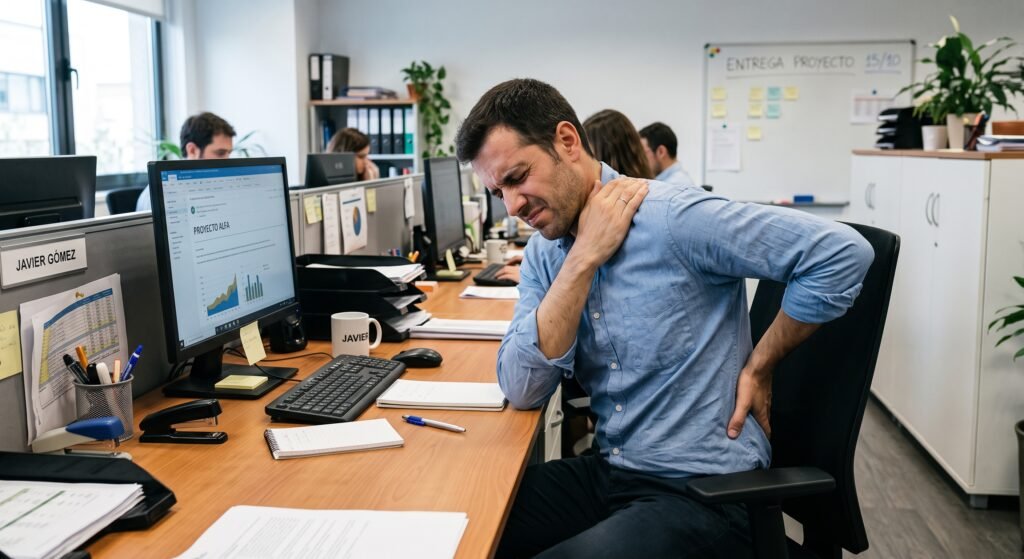
Why Does My Back Hurt More When I’m Stressed?
Why Do I Have Knots in My Back? And Can Massage Actually Get Rid of Them?

Do Tall People Have More Neck & Back Pain?