Why Do I Have Knots in My Back? And Can Massage Actually Get Rid of Them?
A Physiotherapy-Informed Guide to Muscle Knots, Trigger Points and Back Tension
You know the spot.
That incredibly annoying place somewhere between your shoulder blade and your spine.
You can’t quite reach it properly with your own hand.
So naturally, humanity has invented several highly scientific treatment methods.
Leaning against the corner of a wall.
Rolling on a tennis ball.
Using the edge of a door frame.
Asking your partner to press one finger directly into it.
Or my personal favourite:
“Can you just put your elbow there?”
For a few glorious seconds, it feels amazing.
Almost like you’ve discovered the secret location of every problem in your upper back.
Then three days later…
It’s back.
Exactly the same place.
Which leads many people to ask me during massage:
“Why do I keep getting these knots?”
It’s a great question.
The answer is just a little different from what most of us were taught.
Because despite how convincing they feel…
Your muscles probably aren’t literally tying themselves into knots.
The term muscle knot is something almost everyone understands—but it isn’t a precise medical diagnosis.
People use it to describe an area that feels tight, tender, sensitive or unusually uncomfortable when pressure is applied.
Those sensations are completely real.
The explanation, however, is more complex than imagining a tiny knot of muscle fibres that simply needs to be crushed until it disappears.
Understanding that difference changes the way we think about massage entirely.
Instead of asking:
“How do I break this knot?”
A much more useful question becomes:
“Why does this area keep feeling tense in the first place?”
In This Guide
- What people really mean when they say “muscle knot”.
- Why knots often appear around the shoulders and upper back.
- Are trigger points the same thing as muscle knots?
- Why pressing a knot can feel strangely satisfying.
- Why the same painful spot keeps returning.
- Can massage actually remove muscle knots?
- Is Deep Tissue Massage always the best option?
- When recurring back tension deserves further assessment.
- How massage fits into long-term recovery rather than temporary relief alone.
First: What Is a Muscle Knot?
If you’ve ever pointed to one exact place on your back and said:
“It’s right there.”
You’re not alone.
Clients do this every week.
Sometimes it’s beside the shoulder blade.
Sometimes it’s the top of the shoulders.
Others describe a small painful point near the base of the neck.
And nearly everyone uses the same word.
Knot.
The interesting thing is that healthcare professionals don’t usually use the phrase as a precise anatomical diagnosis.
That’s because when someone says they have a knot, they may be describing several different experiences:
A tight feeling.
A tender area.
A sensitive point.
A region that feels harder than surrounding tissue.
A place that produces discomfort when pressure is applied.
Or an area that simply makes them desperately want somebody to massage it.
Those experiences are real.
The important part is understanding that the word knot describes how something feels, not necessarily exactly what structure is physically happening underneath your fingers.
Are There Actually Knots Inside Your Muscles?
This is where one of massage’s biggest myths begins.
Imagine a shoelace.
It twists.
It tangles.
Eventually it forms a knot.
Many people unconsciously imagine muscles doing something similar.
A little bundle of fibres somehow becomes tangled and remains trapped until a massage therapist heroically breaks it apart.
It’s a wonderful visual.
It’s also probably not an accurate representation of what’s happening.
Muscles are living, constantly adapting tissues.
They contract.
Relax.
Respond to movement.
Respond to load.
Receive blood supply.
Communicate continuously with the nervous system.
They aren’t ropes that become physically tied into little knots throughout the day.
That doesn’t mean the area you’re feeling is imaginary.
Quite the opposite.
It simply means the sensation deserves a more sophisticated explanation.
Why Does a Knot Feel So Real Then?
Because your body is exceptionally good at producing sensations.
When an area becomes particularly sensitive, tight or uncomfortable, your brain doesn’t label it:
“Hello. There appears to be altered sensory processing involving multiple contributing factors.”
It says:
“Ouch. There’s a knot.”
And honestly?
That’s much easier to say.
The experience of tightness can involve muscular activity, fatigue, previous physical demands, stress, reduced movement and how your nervous system is interpreting information from that region.
Several different factors can create remarkably similar sensations.
That’s one reason two people may describe identical “knots” while having completely different underlying reasons for feeling them.
What About Trigger Points?
You’ve probably heard this term too.
Trigger point.
Sometimes people use trigger point and muscle knot as though they’re interchangeable.
They’re related in everyday conversation, but they’re not exactly the same idea.
A trigger point is generally used to describe a sensitive area within muscle that may be painful when compressed and, in some cases, may produce pain elsewhere.
Researchers continue studying exactly how trigger points develop and how they should be understood.
There is still discussion within the scientific community about their mechanisms and even how reliably they can be identified.
That’s important because it reminds us to stay humble.
We don’t need to pretend we completely understand every painful spot simply because we’ve given it a name.
What matters most is listening to what the person is experiencing.
Why Are Knots So Common Around the Shoulders?
Now we’re getting somewhere.
There are certain areas that seem almost universally famous.
The upper trapezius.
The muscles between the shoulder blades.
The region around the base of the neck.
Why there?
Partly because those areas participate in many everyday activities.
Working at a laptop.
Driving.
Using your phone.
Carrying a backpack.
Standing for long periods.
Training.
Giving treatments.
Even sitting while concentrating can involve low-level muscular activity around the shoulders and upper back.
Again, that doesn’t mean these muscles are being damaged every time you answer an email.
It simply means they’re frequently involved in supporting and moving your upper body throughout the day.
And sometimes…
They become the areas that complain the loudest.
The Famous Shoulder Blade Knot
Let’s talk about that one.
You know exactly which one I mean.
It’s usually somewhere between the inside edge of the shoulder blade and the spine.
You discover it accidentally.
Perhaps while changing clothes.
Maybe while leaning against a chair.
Or during a massage when you suddenly announce:
“OH MY GOD. THAT’S THE KNOT.”
What’s fascinating is that this area often becomes a magnet for attention.
People spend months attacking it with massage guns, tennis balls, foam rollers and increasingly creative household objects.
Yet the spot often returns.
Why?
Because maybe the goal was never to destroy the spot.
Maybe that area is repeatedly becoming sensitive because it’s continuously participating in the same physical demands.
Your laptop hasn’t disappeared.
Your stressful week hasn’t disappeared.
Your twelve-hour flight still happened.
Your backpack still weighs the same.
The body remembers routine remarkably well.
And that’s why recurring tension often deserves curiosity rather than warfare.
Why Do Knots Keep Coming Back?
This is perhaps the question I hear more than any other.
Someone receives a wonderful massage.
They leave feeling lighter.
The shoulders move beautifully.
That annoying point beside the shoulder blade feels dramatically less noticeable.
Success.
Three days later…
“Lina, it’s back.”
The natural conclusion is:
“The massage didn’t remove it properly.”
But that’s not necessarily true.
Recurring sensations don’t automatically mean something failed.
They may simply mean your body returned to the same demands that contributed to the discomfort in the first place.
Think about it like wrinkles on a bedsheet.
You smooth the sheet beautifully.
Then somebody sleeps on it again.
The wrinkles return—not because smoothing was useless, but because life continued happening.
Massage may provide temporary relief, improved comfort and reduced sensitivity for many people.
But it doesn’t remove your laptop from existence.
Unfortunately.
I’ve checked.
Before We Blame the Knot…
Whenever someone tells me they’ve had the same knot for months, I become much more interested in their story than the knot itself.
I want to know:
When do you notice it most?
After work?
After training?
During stressful weeks?
After travelling?
When you wake up?
Only on one side?
Does movement help?
Does sitting make it worse?
Those answers often reveal much more than simply pressing harder into one painful point.
Because a knot isn’t always the beginning of the story.
Sometimes…
It’s the final sentence.
And to understand why it keeps appearing, we need to look at everything that happened before it.
Why Does Pressing a Muscle Knot Feel So Good?
This is one of the strangest things about muscle knots.
You find a sensitive point.
You press it.
It hurts.
And your immediate reaction is:
“Yes. Right there. Don’t stop.”
Logically, this seems slightly ridiculous.
If touching an area produces discomfort, why can the pressure also feel satisfying?
The answer probably involves more than one mechanism.
Pressure provides strong sensory input to the nervous system.
Touch, movement, expectation, attention and context can all influence how an area feels.
Massage may temporarily change the way your nervous system interprets sensations coming from that region.
And sometimes that produces the experience clients describe perfectly as:
“It hurts… but in a good way.”
The Famous “Good Pain”
Massage therapists hear this phrase constantly.
Good pain.
Usually, clients mean pressure that feels intense but satisfying.
You can breathe normally.
Your body isn’t trying to escape.
You aren’t involuntarily contracting every muscle around the area.
And although the sensation is strong, something about it feels relieving.
That’s very different from pain that feels sharp, burning, electrical, frightening or simply wrong.
One deserves communication and adjustment.
The other deserves…
also communication and adjustment.
Because even “good pain” doesn’t need to become a competition.
More Pain Does Not Mean More Benefit
This is one of the most important myths I want to challenge.
Some people arrive for Deep Tissue Massage believing that if they can tolerate enough pain, we’ll finally destroy the knot.
Teeth clenched.
Hands gripping the massage table.
Breath held.
Entire body fighting for survival.
Meanwhile:
“No, no. It’s fine. You can go harder.”
Dear…
Your toes are making a fist.
Massage isn’t an endurance test.
And pain isn’t a measurement of treatment quality.
There may be moments when stronger pressure feels appropriate and satisfying.
But increasing pressure simply because an area feels tight doesn’t guarantee a better result.
Your Nervous System Is Part of the Massage
When we talk about massage, it’s tempting to imagine that I’m only working on muscles.
Pressure goes in.
Muscle changes.
Problem solved.
But massage is also a sensory experience.
Your skin, muscles, connective tissues and nervous system continuously send and receive information.
The environment matters.
Your expectations matter.
Whether you feel safe and comfortable matters.
How much pressure you expect matters.
Your previous experiences with massage can matter.
Even whether you trust the person touching you can influence the experience.
That’s one reason exactly the same pressure may feel wonderful one day and excessive another.
Your body isn’t a piece of dough that responds identically every time somebody presses it.
Why Pressure Can Change How a Spot Feels
Imagine that annoying area beside your shoulder blade has been demanding your attention all afternoon.
You notice it while working.
You move your shoulder.
Still there.
You stretch.
Still there.
Then somebody applies slow, controlled pressure to the area.
Suddenly your nervous system receives a very different kind of sensory information.
For a while, the sensation changes.
Perhaps the area feels warmer.
Maybe movement feels easier afterwards.
Perhaps the spot simply becomes less noticeable.
This doesn’t necessarily mean something physically “broke apart.”
It means the experience of that area has changed.
And honestly, if you’ve spent three days wanting to remove your own shoulder blade…
That can feel pretty fantastic.😂
Can Massage Increase Blood Flow to a Knot?
You’ll often hear claims that massage “flushes toxins” or that a knot exists because blood has become trapped inside the muscle.
That’s an oversimplification.
Massage can influence local circulation, but describing massage as squeezing toxins out of a muscle knot isn’t an accurate explanation of what happens.
Your body already has highly sophisticated systems responsible for processing and eliminating metabolic waste.
They’re called things like:
Your liver.
Your kidneys.
Your lungs.
They’ve been working on this project for quite a while.
You don’t need me to manually push mysterious toxins from your trapezius toward the nearest exit.
Do You Need to Drink Lots of Water to “Flush Out the Knots”?
This myth deserves a little side quest.
Should you drink water after a massage?
Of course.
If you’re thirsty.
Hydration is important for normal health.
But you don’t need to force yourself to drink litres of water because massage supposedly released toxins into your bloodstream.
It didn’t.
Drink normally.
Listen to your thirst.
Your kidneys know what they’re doing.
No emergency detox operation required.
Why Does the Knot Sometimes Feel Softer After Massage?
This is where language becomes tricky.
Clients often touch an area after treatment and say:
“It’s gone! It’s so much softer.”
And that change may feel completely real.
Muscle tone can change.
Sensitivity can change.
How you’re holding the area can change.
Your perception of tension can change.
The surrounding tissues may feel different after movement, warmth, touch and pressure.
What I wouldn’t automatically conclude is:
“Excellent. I physically crushed the knot into submission.”
Bodies aren’t that mechanical.
Something can feel dramatically different without us needing to imagine that a tiny anatomical lump has been destroyed.
Why Can a Knot Hurt Somewhere Else?
Here’s where trigger points become particularly interesting.
Sometimes pressure applied to one area produces a sensation somewhere else.
You press around the shoulder.
The person feels something toward the neck.
You work around another region and they recognise a familiar sensation elsewhere.
This phenomenon is often discussed as referred pain.
Trigger-point models have traditionally described characteristic patterns of referred sensation from certain muscles.
However, the science surrounding myofascial trigger points is still debated, including exactly what they represent biologically and how reliably practitioners can identify them.
So I prefer not to pretend every referred sensation gives us a perfect anatomical map.
The sensation is useful information.
It isn’t necessarily a GPS coordinate telling us exactly where the “problem” lives.
The Most Painful Spot Isn’t Always the Most Important Spot
This is something clients sometimes find surprising.
You show me one incredibly sensitive point.
Naturally, you expect me to spend the next 45 minutes attacking it.
But if an area is already highly sensitive, endless aggressive pressure may simply irritate it.
Instead, I may work around it.
Explore neighbouring areas.
Move toward the neck.
Work around the shoulder blade.
Address the upper back more broadly.
Maybe include the arms if your work involves repetitive use.
Then return to the sensitive point later.
Sometimes it feels completely different.
That’s why I don’t think massage should be:
Find pain → attack pain.
The body deserves slightly more imagination than that.
Why Do Some People Love Deep Pressure?
Individual preference plays a huge role.
Some people genuinely enjoy strong pressure.
They relax into it.
They breathe normally.
They describe the sensation as deeply satisfying.
Other people experience the exact same pressure and immediately tense.
Neither person is doing massage “correctly.”
And body size doesn’t predict this particularly well either.
A large, muscular client may prefer moderate pressure.
A smaller client may happily ask me:
“Can you go deeper?”
And five minutes later:
“Deeper.”
And then:
“A little deeper.”
At which point I begin wondering whether I need construction equipment.
Pressure preference is individual.
That’s why communication during massage matters.
Does Deep Tissue Massage Remove Knots Better?
Not automatically.
Deep Tissue Massage can be useful when someone enjoys and responds well to more focused pressure.
But the goal shouldn’t be to apply the maximum force your body can tolerate.
A muscle knot isn’t a walnut.
I don’t receive bonus points for cracking it.
Slow pressure.
Moderate pressure.
Movement.
Broader massage.
Focused techniques.
Relaxation.
Different approaches may all be appropriate depending on the person and what they’re experiencing.
The best massage isn’t necessarily the deepest one.
It’s the one your body responds well to.
What If I Want You to Press Harder?
Tell me.
Communication is part of treatment.
If you enjoy deeper pressure and your body responds comfortably, we can adapt.
Likewise, if something feels too intense, tell me immediately.
You don’t need to tolerate pain because you think disappointing your massage therapist would be rude.
Trust me.
I’ll survive.
I’d much rather adjust the pressure than discover afterwards that you spent an hour silently negotiating with your ancestors.
But Why Does the Relief Sometimes Last Only a Few Days?
And now we arrive at the really important question.
You’ve had the knot massaged.
It felt fantastic.
The area became less sensitive.
Maybe you even forgot about it completely.
Then several days later…
There it is again.
Does that mean massage only “covered up” the problem?
Not necessarily.
But it does tell us something important.
Your symptoms exist within your life.
If your neck and shoulders are responding to ten-hour computer days, those computer days continue after the massage.
If training has increased dramatically, that workload still exists.
If you’ve been sleeping poorly, massage doesn’t manufacture eight hours of sleep for you.
If you’re under enormous stress, one hour of relaxation doesn’t remove the situation creating that stress.
And if you’ve been using the same tennis ball on exactly the same spot every night for six months…
Perhaps it’s time we became curious about something other than the tennis ball.
The Question Isn’t Only “Where Is the Knot?”
It’s also:
Why here?
Why now?
Why does it return?
What makes it better?
What makes it worse?
Those questions take us beyond temporary relief.
Because massage can be wonderful at changing how an area feels.
But if we want to understand recurring tension, we also need to understand the person carrying it.
Their work.
Their training.
Their movement.
Their sleep.
Their stress.
Their routines.
Their environment.
And sometimes their medical history.
That’s when a “knot” stops being something we need to defeat…
And becomes useful information about what the body has been experiencing.
Why Does the Same Muscle Knot Keep Coming Back?
This is probably the most frustrating part.
Not simply having a knot.
Having your knot.
The one you’ve known for years.
You could probably point to it with your eyes closed.
You massage it.
Stretch it.
Roll it.
Press it against a wall.
Occasionally threaten it.
It improves.
Then eventually…
Hello again.
When the same area repeatedly becomes uncomfortable, it’s tempting to imagine that the knot was never properly removed.
But perhaps nothing needs to be removed.
Maybe the area keeps responding to something that keeps happening.
And that’s where things become much more interesting.
Your Daily Routine Didn’t Disappear After the Massage
Imagine your upper back becomes uncomfortable after long working days.
You receive a massage on Saturday.
It feels fantastic.
Sunday?
Still fantastic.
Monday morning?
Pretty good.
Then comes:
Monday’s laptop.
Tuesday’s meetings.
Wednesday’s deadlines.
Thursday’s seven hours behind a screen.
Friday’s decision to answer emails from the sofa like a human croissant.
And suddenly that familiar spot starts talking again.
This doesn’t necessarily mean the massage “wore off.”
Your body simply returned to its normal environment and workload.
Massage changes one part of the equation.
Your daily life provides the rest.
Desk Work and the Famous Shoulder-Blade Knot
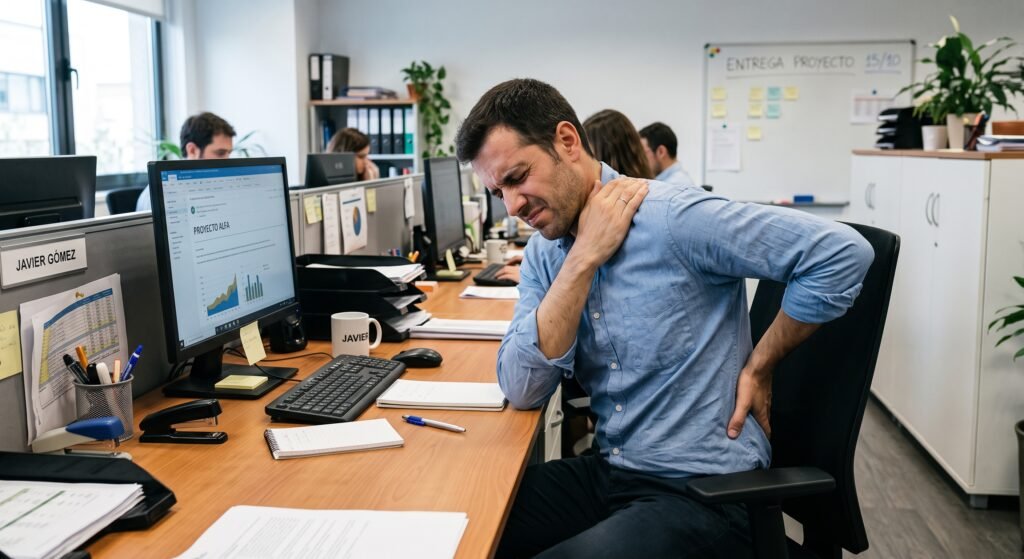
If your knot lives somewhere around the upper back or shoulder blade, desk work deserves consideration.
Not because sitting is inherently dangerous.
And not because your posture is secretly destroying your spine.
As we discussed in Can Massage Help With Tech Neck?, the bigger issue may be spending long periods with relatively little variation.
Your hands remain in front of you.
Your eyes focus on a screen.
Your arms repeatedly use the keyboard and mouse.
Your neck and shoulders perform low-level work.
For hours.
If that area regularly becomes sensitive after computer work, you don’t necessarily need to discover the one forbidden posture causing it.
You may simply need more movement options throughout the day.
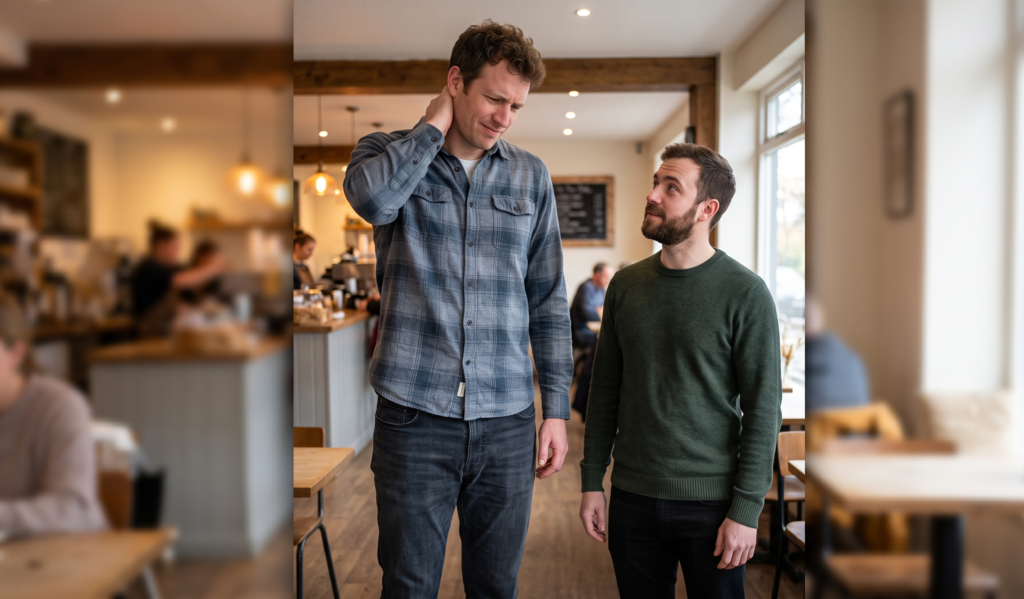
Tall People May Recognise This Too
This is where our discussion about height and upper-back tension becomes relevant.
Being tall doesn’t automatically cause muscle knots.
But if your desk, screen, kitchen counter or working surface doesn’t comfortably fit your proportions, your body may repeatedly adapt to the environment.
Perhaps you lean slightly further toward the laptop.
Maybe the desk feels too low.
Perhaps you’re constantly working over surfaces designed for someone shorter.
Again, none of these positions is inherently harmful.
But repeated physical demands can influence how certain areas feel.
Sometimes the question isn’t:
“Why does my knot keep coming back?”
It’s:
“Why does my environment keep asking the same area to work like this?”
Stress Can Make Familiar Areas Feel Louder
Then there’s stress.
And this one matters.
You’ve probably noticed that your body doesn’t feel exactly the same during a peaceful holiday and during the week when everything goes wrong simultaneously.
Deadlines.
Poor sleep.
Work problems.
Personal responsibilities.
Notifications.
That email beginning:
“Just following up…”
Some people notice themselves clenching their jaw when stressed.
Others elevate their shoulders.
Some become less physically active.
Others sleep poorly.
And stress can also influence how we experience pain and bodily sensations.
So if your famous knot becomes particularly noticeable during stressful periods, that doesn’t mean the sensation is imaginary.
It means the nervous system and musculoskeletal system don’t exist in completely separate universes.
Your body knows when life has been a lot.
Don’t Forget the Jaw
This one surprises people.
If your tension tends to live around the neck, upper shoulders or base of the skull, it can sometimes be useful to notice what your jaw is doing.
Are you clenching while concentrating?
Do you wake up with jaw tension?
Do you catch yourself pressing your teeth together during stressful moments?
This doesn’t mean your jaw is secretly responsible for every shoulder knot.
But the jaw, head and neck work within the same broader system.
If you’re constantly clenching while your shoulders are already tense, that’s useful information.
Sometimes the body has several browser tabs open too.
Training Can Create Its Own Version of a “Knot”
Not every recurring tight spot comes from sitting.
Sometimes it’s the opposite.
You train.
Pull-ups.
Rows.
Deadlifts.
Boxing.
Swimming.
Climbing.
Weight training.
Then you notice a familiar area around the upper back or shoulders.
Exercise is good for you.
That doesn’t mean your muscles are forbidden from becoming tired after you use them.
If your training volume increases, your body has to adapt to that workload.
A feeling of muscular tension doesn’t automatically mean you’ve injured yourself or developed a pathological knot.
Sometimes you’ve simply asked an area to do more than usual.
Recovery matters.
So does gradually managing load.
And Sometimes Work Is the Workout
This is something people forget.
Not everyone spends their working day at a desk.
Some jobs are extremely physical.
Healthcare professionals.
Hospitality workers.
Hairdressers.
Chefs.
Personal trainers.
Construction workers.
Massage therapists.
Yes.
Us too.
Reaching.
Lifting.
Standing.
Bending.
Using your hands.
Repeating the same movements throughout the day.
Your body doesn’t care whether the physical load came from a gym membership or your salary.
Workload is workload.
So when investigating recurring tension, your occupation matters.
Sleep Can Change How Your Body Feels
Now imagine two identical days.
Same job.
Same workout.
Same desk.
Same body.
But one follows eight hours of excellent sleep.
The other follows four.
Would you expect yourself to feel identical?
Probably not.
Sleep influences recovery, mood, energy and pain sensitivity.
That doesn’t mean every knot is caused by poor sleep.
But if your body feels significantly more sensitive during periods when you’re exhausted, that’s worth noticing.
Sometimes the answer isn’t another mobility exercise.
Sometimes it’s Tuesday night and you need to go to bed.
Revolutionary wellness advice.
Do You Need to Stretch More?
Maybe.
But stretching isn’t automatically the antidote to every sensation of tightness.
If stretching feels good, wonderful.
Move your body.
Explore comfortable ranges.
Give the area something different to do.
But you don’t necessarily need to spend twenty minutes aggressively pulling on a muscle because it feels tight.
The sensation of tightness doesn’t always mean a muscle is physically too short.
That’s an important distinction.
You can feel tight without needing to be “lengthened.”
What About Foam Rollers, Tennis Balls and Massage Guns?
I have no intention of taking away your tennis ball.
Self-massage tools can feel great.
A foam roller may provide pressure and movement.
A massage gun can provide strong sensory input.
A tennis ball can reach that irritating spot between the shoulder blade and spine surprisingly well.
If they feel comfortable and you’re using them sensibly, fine.
The problem begins when self-treatment becomes warfare.
More pressure.
Harder ball.
Longer sessions.
Higher massage-gun setting.
Every single day.
All because you’re convinced there’s something inside the muscle that needs to be destroyed.
Remember:
The goal is to change how the area feels—not win a fight against it.
Movement Snacks Can Be More Useful Than One Giant Stretching Session
If your discomfort tends to appear after prolonged sitting or repetitive work, consider changing the pattern throughout the day.
Stand.
Walk.
Move your shoulders.
Rotate your upper body.
Change your working position.
Take a phone call while walking.
Move your arms through comfortable ranges.
None of these is a magical muscle-knot exercise.
That’s exactly why I like them.
You’re simply giving your body more variety.
Five small opportunities to move throughout the day may make more sense for your routine than waiting until 9 p.m. to perform an elaborate corrective ritual because your shoulders are furious.
Strength Can Be Part of the Answer Too
Recurring tension doesn’t automatically mean an area needs to become looser.
Sometimes increasing physical capacity can be useful.
General resistance training exposes muscles to varied and progressively manageable loads.
Your upper back.
Shoulders.
Arms.
Trunk.
All can become stronger and more capable.
This doesn’t mean you need a special “anti-knot workout.”
And strength training isn’t a guarantee against pain.
But if your entire strategy has been:
Stretch → massage → stretch → massage → attack with tennis ball → repeat
…perhaps adding appropriate strength and general physical activity deserves consideration.
Your body isn’t only something to loosen.
It’s something to use.
Stop Checking the Knot Every Ten Minutes
This sounds silly.
But people do it.
You find a tender point.
Then you check it.
Still tender.
Twenty minutes later…
Check again.
Still there.
Before bed?
Quick check.
Morning?
Good morning, knot.
Constantly pressing an already sensitive area can keep your attention focused on it and may simply irritate the tissue further.
You don’t need to repeatedly test whether the spot still hurts.
Give it some space.
Move normally.
See how it behaves during actual activities.
Sometimes the most useful information isn’t whether pressing hard hurts.
It’s whether the area is interfering with your life.
When a “Knot” Deserves More Than Massage
This part matters.
Not every persistent painful area should be treated indefinitely as a muscle knot.
If symptoms are severe, progressively worsening, associated with significant trauma, or accompanied by pronounced weakness, persistent numbness or tingling, fever, unexplained illness, coordination problems or other unusual neurological symptoms, seek appropriate medical assessment.
Likewise, if an area has remained persistently painful, repeatedly disrupts sleep or significantly interferes with normal daily activity, getting it properly assessed may be more useful than endlessly attacking it with massage.
Massage has a role.
It doesn’t need to pretend to be every role.
What Should You Do Between Massage Sessions?
Keep it simple.
You don’t need a 17-step muscle-knot protocol.
Pay attention to patterns.
Move regularly.
Exercise in ways you enjoy.
Manage training load appropriately.
Make your workspace reasonably comfortable.
Sleep as well as your life allows.
Use self-massage if it feels good—but don’t turn it into punishment.
And notice what tends to happen before your symptoms appear.
You may discover that your knot isn’t random at all.
Maybe it appears after long computer days.
During stressful weeks.
After increasing training.
When travelling.
Or when your routine becomes unusually sedentary.
That’s useful information.
Because instead of endlessly asking:
“How do I get rid of this knot?”
you can begin asking:
“What helps this area feel better—and what keeps asking it to become sensitive again?”
That’s a much more powerful question.
Your Knot Doesn’t Need an Enemy
I understand the temptation.
There’s a painful point.
Naturally, we want to defeat it.
Crush it.
Release it.
Break it.
Eliminate it forever.
But your body isn’t fighting against you.
That sensitive spot may simply be responding to workload, stress, movement, recovery and everything else happening around it.
So rather than treating the knot like an enemy…
Get curious.
Massage it if massage feels good.
Move.
Train.
Rest.
Adjust what you can.
And pay attention to patterns.
Because sometimes the most useful thing a recurring knot gives you isn’t a problem to solve.
It’s information to understand.
So… Can Massage Actually Get Rid of Muscle Knots?
After an entire article discussing what muscle knots may—or may not—be, we’ve finally arrived at the question everyone wants answered.
Can massage get rid of them?
The most accurate answer is:
Massage can change how a “knot” feels, sometimes quite dramatically.
What I wouldn’t claim is that I’m physically untangling muscle fibres or permanently removing a tiny lump from inside your back.
That’s probably not what’s happening.
Massage may temporarily reduce pain or sensitivity.
An area may feel less tense.
Movement may feel more comfortable.
You may stop noticing the spot altogether.
And sometimes that change lasts for quite a while.
That’s meaningful.
We simply don’t need an imaginary anatomical knot to explain why.
Relief Doesn’t Have to Be Permanent to Be Valuable
This is something I think we sometimes get wrong when talking about massage.
If a symptom eventually returns, we assume the treatment failed.
But think about other things we do because they make our bodies feel better.
Exercise.
Walking.
Stretching.
Sleeping.
Taking a warm shower.
Resting after a demanding week.
Nobody says:
“Sleep clearly doesn’t work. I got tired again the next day.”
Some health behaviours are useful precisely because they’re repeated as part of normal life.
Massage can be similar.
Temporary relief can still be valuable.
The important question is whether the treatment helps you and whether recurring symptoms suggest that something else in the bigger picture also deserves attention.
What I Actually Do When You Tell Me “I Have a Knot”
First:
I listen.
That sounds obvious, but it’s important.
I want to know where you feel it.
How long you’ve noticed it.
Whether it’s always in exactly the same place.
What makes it worse.
What makes it feel better.
What you do for work.
Whether you train.
Whether you’ve been travelling.
And whether anything about the symptoms suggests massage might not be the appropriate first option.
Then we begin the session.
And I don’t necessarily attack the painful spot immediately.
I Don’t Spend 60 Minutes Fighting One Point
Imagine you show me a sensitive point beside your right shoulder blade.
We could spend the entire session pressing it.
Harder.
Deeper.
More elbow.
More suffering.
Eventually both of us would need treatment.
Instead, I prefer looking at the surrounding area.
Depending on what you’re experiencing, I may work around the:
- Neck.
- Upper shoulders.
- Upper and mid-back.
- Shoulder blades.
- Base of the skull.
- Arms and forearms.
- Pectoral region when appropriate.
Then I can return to the sensitive area and see how it feels.
Sometimes the sensation has already changed.
The body is connected.
Treatment should acknowledge that.
Therapeutic Massage for Recurring Back Tension
If your main concern is a persistent or recurring area of tension, Therapeutic Massage may be appropriate.
This doesn’t mean every therapeutic session needs to be aggressive.
Therapeutic simply means the session has a specific purpose based on what you’re experiencing.
Maybe your upper back feels overloaded after desk work.
Perhaps your shoulders are tired from physical work.
Maybe you’re recovering from a demanding week of training.
Or you’ve spent several hours travelling and your neck feels unusually stiff.
The techniques and pressure can then be adapted to that context.
Your massage should respond to you.
Not to a predetermined routine.
And Where Does Deep Tissue Massage Fit?
Deep Tissue Massage can absolutely be part of the session when appropriate.
Some clients love deeper pressure.
And certain areas may respond comfortably to slower, more focused work.
But remember:
Deep doesn’t automatically mean effective.
If your entire body is bracing against the table, we’re probably not achieving what you imagined when you asked me to “release the knot.”
I prefer enough pressure to create a useful experience without turning the treatment into a battle between my elbow and your trapezius.
Nobody needs that sequel.
Massage for Back Knots in Barcelona
If you’ve found this article because you’ve been searching for massage for stubborn back or shoulder knots in Barcelona, you’re welcome to visit me at my private massage studio in Eixample.
Clients often come to me describing tension around the:
Neck.
Shoulders.
Upper back.
Lower back.
And, of course…
That spot between the shoulder blade and spine.
I know the one.
During your session, we’ll talk about what you’re experiencing and adapt the massage accordingly.
Depending on your needs, I may combine elements of Therapeutic Massage, Deep Tissue Massage, mobility and slower relaxation techniques.
My goal isn’t to convince you that your body is full of problems that need fixing.
It’s to help you feel more comfortable while understanding what may be contributing to the tension you’re experiencing.
Your Massage Doesn’t Need to Be the Same Every Time
This is another reason I prefer personalised sessions.
Maybe last month your neck needed most of the attention.
This week you’ve been training and your upper back feels tired.
Next month you’ve just stepped off a long flight and your legs are complaining instead.
Your body changes because your life changes.
So the massage can change too.
I don’t need to find the same “knots” every session simply because they were there last time.
We work with the body you bring me today.
When Massage Isn’t the Answer
There are times when I would rather tell someone to seek appropriate medical assessment than pretend another massage will solve everything.
If your pain is severe or progressively worsening, follows significant trauma, or is accompanied by pronounced weakness, persistent numbness or tingling, fever, unexplained illness, coordination problems or unusual neurological symptoms, appropriate medical evaluation matters.
Likewise, a persistently painful area that repeatedly disrupts sleep or significantly affects your normal activities deserves proper assessment.
Massage can be wonderful.
But professionalism also means recognising when massage isn’t the appropriate tool.
Frequently Asked Questions
What is a muscle knot?
“Muscle knot” isn’t a precise medical diagnosis.
People generally use the term to describe an area of muscle that feels tight, tender, sensitive or painful when pressure is applied.
The sensation is real, but it doesn’t necessarily represent muscle fibres physically tied into a knot.
Are muscle knots the same as trigger points?
The terms are often used interchangeably in everyday conversation, but they’re not necessarily identical.
Myofascial trigger points are generally described as sensitive areas associated with pain and sometimes referred sensations.
However, their underlying mechanisms and how reliably they can be identified continue to be discussed scientifically.
Can massage remove muscle knots?
Massage may temporarily reduce tenderness, tension or discomfort associated with what people describe as muscle knots.
However, it shouldn’t be described as physically untangling or permanently removing knotted muscle fibres.
The goal is improving how the area feels and moves rather than “breaking” something inside the muscle.
Why do my muscle knots keep coming back?
Recurring tension can be influenced by many factors including workload, repetitive activity, prolonged positions, exercise, stress, sleep and individual sensitivity.
If your daily demands remain the same after massage, the same area may become noticeable again.
That doesn’t automatically mean the massage failed.
Why does pressing a muscle knot feel good?
Pressure provides strong sensory input and can temporarily change how a sensitive area feels.
Some people enjoy intense but comfortable pressure—the famous “good pain.”
However, more pain doesn’t necessarily produce a better result.
Should massage hurt when working on knots?
Massage doesn’t need to hurt to be effective.
Some people enjoy deeper pressure, while others respond better to moderate or gentle techniques.
Sharp, burning, electrical or otherwise concerning sensations should be communicated immediately.
Is Deep Tissue Massage best for muscle knots?
Not necessarily.
Deep Tissue Massage may be appropriate for people who enjoy and respond well to deeper focused pressure, but maximum pressure isn’t required to address muscular tension.
The best approach depends on the individual.
Can a massage gun get rid of knots?
Massage guns can provide pressure and sensory stimulation that some people find helpful for temporary muscular tension.
But they don’t need to be used aggressively to “destroy” knots.
Avoid repeatedly hammering an already irritated or highly sensitive area simply because you believe more pressure must be better.
Should I drink lots of water after massage to flush out toxins?
No special detoxification is required after massage.
Normal hydration is appropriate, and drinking when you’re thirsty is sensible.
Massage doesn’t require you to flush mysterious toxins out of your muscles.
Your liver and kidneys already have that job covered.
How often should I get massage for recurring knots?
There’s no universal schedule.
Frequency depends on your symptoms, preferences, lifestyle, physical demands and how useful you personally find massage.
If the same painful area continually returns, it’s also worth considering the factors surrounding it rather than assuming you simply need increasingly frequent massage.
When should I worry about a muscle knot?
Seek appropriate assessment if symptoms are severe, progressively worsening, follow significant trauma or involve persistent numbness or tingling, pronounced weakness, coordination changes, fever or other concerning neurological or systemic symptoms.
Persistent pain that significantly interferes with sleep or normal daily activity also deserves proper evaluation.
Where can I get massage for back knots in Barcelona?
I offer personalised massage sessions at my private studio in Eixample, Barcelona, including Therapeutic and Deep Tissue approaches for clients experiencing muscular tension around the back, neck and shoulders.
Sessions are adapted according to your symptoms, pressure preferences and how your body responds during treatment.
Continue Reading
If you’ve ever wondered why your body feels the way it does, you may also enjoy:
- Do Tall People Have More Neck & Back Pain?
- Deep Tissue vs Therapeutic Massage: Which One Is Right for You?
- Is It Normal to Feel Sore After a Massage?
- What Happens to Your Body During a 60-Minute Massage?
- How Often Should You Get a Massage?
- Morning or Evening Massage: Which Is Better?
These guides explore massage, pain and recovery without turning every sensation in your body into something that needs to be “fixed.”

Massage for Neck and Shoulder Pain in Barcelona: Which Massage Should You Choose?

Massage for Back Pain in Barcelona: Which Treatment Should You Choose?

Why Does My Back Hurt More When I’m Stressed?
Why Do I Have Knots in My Back? And Can Massage Actually Get Rid of Them?
Do Tall People Have More Neck & Back Pain?