

Can Massage Help With Tech Neck?
A Physiotherapy-Informed Guide to Neck Pain From Laptops, Phones and Desk Work
Your laptop is open.
Your shoulders have slowly moved forward.
Your head is slightly closer to the screen than it was an hour ago.
And somewhere between the fourth email, the sixth browser tab and another “quick” meeting, you notice it.
That familiar tension.
Right at the base of your neck.
Maybe it spreads toward your shoulders.
Perhaps there’s a stubborn spot between your shoulder blades.
You straighten your posture.
It feels better.
Five minutes later…
You’re in exactly the same position again.
Welcome to what the internet loves to call:
Tech neck.
But here’s the interesting part.
Your posture may not be the villain you’ve been told it is.
And fixing tech neck isn’t necessarily about forcing yourself to sit perfectly straight for eight hours a day.
The real story is considerably more interesting.
“Tech neck” isn’t a medical diagnosis.
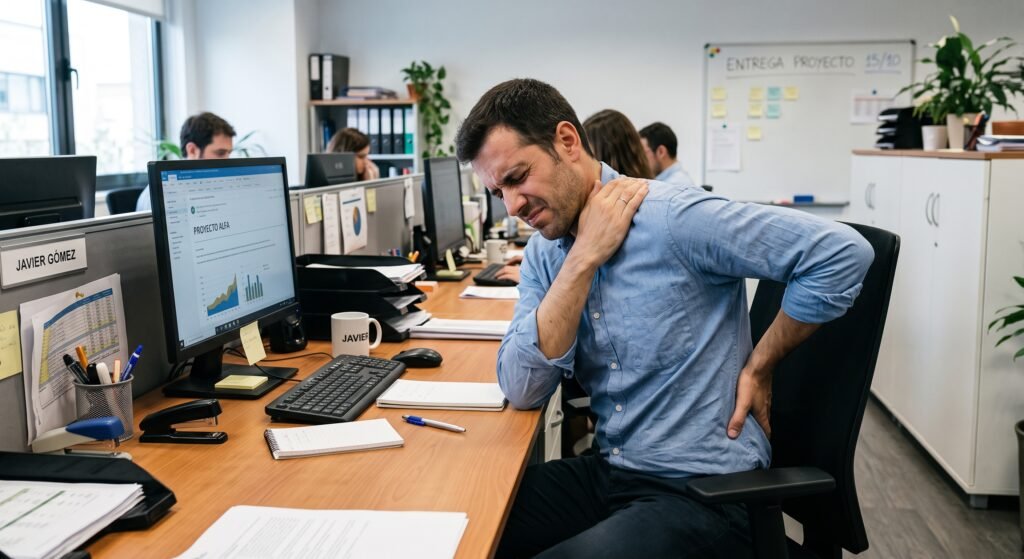
It’s a popular term used to describe neck, shoulder and upper-back discomfort commonly associated with spending long periods using computers, tablets and smartphones.
Posture can influence how your body feels, but there isn’t one universally “perfect” posture that prevents neck pain.
Often, the bigger problem is simpler:
We stay in the same position for too long.
Movement, workload, stress, sleep, physical activity and individual sensitivity can all influence how your neck feels.
And that’s exactly why managing tech neck usually requires more than simply being told to “sit up straight.”
In This Guide
- What tech neck actually means.
- Why laptop and phone use can make your neck feel stiff.
- Whether poor posture really causes neck pain.
- Why your shoulders become tense while working.
- What happens when you stay in one position for hours.
- Whether massage can help with tech neck.
- When Deep Tissue Massage may—or may not—be appropriate.
- Simple habits that can help between massage sessions.
- When neck pain deserves medical assessment.
First: What Exactly Is Tech Neck?
Despite how commonly the phrase appears online, tech neck isn’t a specific medical condition.
It’s an informal term describing a collection of symptoms people often notice after prolonged use of screens.
These may include:
- Neck stiffness.
- Shoulder tension.
- Upper-back discomfort.
- Headaches in some people.
- Fatigue around the neck and shoulders.
- Discomfort when turning the head.
- A feeling that you constantly need to stretch your neck.
And although smartphones receive much of the blame, phones aren’t the only culprit.
Laptop work can create similar problems.
So can long meetings.
Gaming.
Reading.
Driving.
Working at a treatment table.
Or almost any activity that keeps your body in one position for an extended period.
That last point matters.
Because the problem isn’t necessarily that you’ve discovered a “bad” position.
The problem may simply be that your body hasn’t changed position for the last two hours.
Is Bad Posture Really Causing Your Neck Pain?
This is where things get interesting.
For years, people with neck pain have been shown diagrams of “good posture” and “bad posture.”
Head forward?
Bad.
Shoulders rounded?
Bad.
Back perfectly straight?
Good.
The human body, however, doesn’t work quite that simply.
Research into posture and musculoskeletal pain suggests the relationship is much more complex.
People can have visibly forward-head posture without experiencing pain.
Others can sit with what appears to be excellent posture and still develop neck discomfort.
That doesn’t mean posture is irrelevant.
Certain positions may become uncomfortable, particularly when maintained for long periods.
But there probably isn’t one perfect posture that everyone should maintain throughout the entire working day.
Instead of obsessing over the perfect position, I prefer a much more practical idea:
Your best posture is often your next posture.
Move.
Adjust your chair.
Lean back.
Stand for a while.
Look away from the screen.
Walk around.
Then sit differently again.
Your body was designed to tolerate many positions.
What it tends to enjoy less is being asked to remain in exactly the same one for hours.
Why Your Head Feels So Heavy After Hours at a Laptop
Your head already has weight.
Your neck muscles manage that weight all day without you thinking about it.
But when you’re concentrating on a screen, it’s common for the head to gradually move forward while the upper back and shoulders remain relatively still.
Your neck muscles then have to maintain that position continuously.
For five minutes?
Usually not a big deal.
For several hours with barely any movement?
That’s a different workload.
Muscles that remain active for prolonged periods can become fatigued and sensitive.
This may contribute to the familiar sensation of wanting to:
Roll your shoulders.
Stretch your neck.
Massage the base of your skull.
Or why not? Ask whoever is sitting next to you:
“Can you just press here for a second?”
You know the spot.
Everyone knows the spot.
Why Your Shoulders Join the Problem
Tech neck rarely stays exclusively in the neck.
The muscles around your shoulders and upper back also contribute to supporting and moving your head, neck and arms.
And then there’s something else happening.
Your hands are constantly working in front of you.
Typing.
Using a mouse.
Holding a phone.
Scrolling.
Reaching.
When you’re concentrating—or stressed—you may also subtly elevate your shoulders without noticing.
Now combine that with several hours of limited movement.
By late afternoon, the result can be that familiar feeling of wearing your shoulders as earrings.
This is why someone may arrive for a massage saying:
“My neck hurts.”
Yet when I begin working, we discover that the shoulders, upper back and areas around the shoulder blades also deserve attention.
The body doesn’t divide itself into neat little sections.
Everything works together.
The Real Problem May Be Repetition, Not Posture
Imagine holding your arm in front of you.
There’s nothing inherently dangerous about that position.
But keep it there for two hours and eventually your muscles will have something to say about it.
The same principle applies to desk work.
Looking slightly downward isn’t automatically harmful.
Rounded shoulders aren’t automatically harmful.
Leaning forward isn’t automatically harmful.
The issue often arises when the same tissues are repeatedly asked to tolerate the same workload without enough variation.
That’s why I don’t particularly like telling people:
“Never sit like that.”
I’d rather say:
“Don’t spend your entire day sitting only like that.”
That distinction matters.
Because the goal isn’t to make you afraid of your posture.
It’s to give your body more opportunities to move.
And This Is Where Massage Gets Interesting
If tech neck isn’t simply a posture problem, then massage shouldn’t be presented as a way of “correcting” your posture either.
I can’t massage you into a permanently perfect sitting position.
And I wouldn’t want to.
What massage can potentially do is much more useful.
It can give areas that have been working continuously an opportunity to relax.
It can address muscular tension around the neck, shoulders and upper back.
It may temporarily improve how comfortable certain movements feel.
And perhaps most importantly, it can help you become aware of just how much tension you’ve been carrying without noticing.
But to understand why that matters…
We need to look at what eight hours behind a screen are actually asking your body to do.
What Eight Hours at a Desk Actually Do to Your Neck
Eight hours at a desk doesn’t necessarily mean eight hours of damage.
That’s an important distinction.
The human body is remarkably adaptable.
Your neck can bend.
Your shoulders can round.
Your spine can flex.
You can lean forward.
None of these positions is inherently dangerous.
The challenge is duration and repetition.
Imagine spending an entire working day moving between only a handful of positions.
Your eyes remain focused at roughly the same distance.
Your hands stay in front of you.
Your arms repeatedly reach toward the keyboard and mouse.
Your head moves relatively little.
And certain muscles continue doing low-level work for hours.
Eventually, fatigue can appear.
Not because your posture has “broken” your body.
But because your body has been asked to perform the same task for a very long time.
Muscle Fatigue Doesn’t Require Heavy Exercise
When we hear the words “muscle fatigue,” we often imagine running, lifting weights or completing an intense workout.
But muscles don’t need heavy resistance to become tired.
Low-level muscular activity maintained for long periods can also become uncomfortable.
This is particularly relevant around the neck and shoulders.
Some muscles help stabilise your head.
Others position your shoulder blades.
Others support your arms while you type, scroll or use a mouse.
Individually, none of these tasks is particularly demanding.
But repeat them for hours with very little variation and the accumulated workload begins to matter.
That’s why you can finish a day at your laptop feeling physically tired even though you’ve barely left your chair.
Stress Can Show Up in Your Shoulders
Now add another ingredient.
Stress.
Deadlines.
Emails.
Notifications.
Meetings.
Clients.
Twenty-seven browser tabs.
And the message that arrives at 5:57 p.m. beginning with:
“Quick question…”
Your emotional state and physical state aren’t completely separate.
When you’re concentrating intensely or feeling stressed, you may notice yourself clenching your jaw, holding your breath or subtly lifting your shoulders.
You probably don’t consciously decide to do any of those things.
They simply happen.
Do it occasionally and it isn’t particularly interesting.
Do it repeatedly throughout a stressful working week and those areas may begin to feel increasingly tired or sensitive.
This is one reason treating tech neck as purely a posture problem misses part of the picture.
Sometimes the neck is carrying more than the weight of your head.
Your Jaw May Be Involved Too
Here’s something people don’t always connect with neck tension.
The jaw.
Some people clench their teeth when concentrating.
Others do it when they’re stressed.
And some may grind or clench during sleep without realising it.
The muscles around the jaw, head and neck don’t function in complete isolation from one another.
So when someone describes tension around the temples, base of the skull, neck and shoulders, it can be useful to consider the bigger picture rather than focusing exclusively on one painful spot.
This doesn’t mean every case of neck pain comes from the jaw.
It doesn’t.
But your symptoms don’t necessarily respect the anatomical boundaries we use to describe the body.
Sleep Changes the Equation
Imagine two identical working days.
Same laptop.
Same desk.
Same chair.
Same posture.
Same eight hours.
On Monday, you slept wonderfully.
On Tuesday, you slept four hours.
Would you expect your body to feel exactly the same?
Probably not.
Sleep influences recovery, energy, mood and how we experience discomfort.
When you’re already tired, physical sensations may become more noticeable.
Your tolerance for prolonged positions may also feel different.
That’s another reason I hesitate when someone says:
“My chair caused my neck pain.”
Maybe the workstation contributed.
But perhaps that week also involved poor sleep, unusual stress, less exercise and considerably more screen time than usual.
Musculoskeletal discomfort rarely comes with one perfectly convenient explanation.
Why Two People With the Same Job Feel Completely Different
Put two people beside each other.
Give them identical laptops.
Identical desks.
Identical chairs.
Identical working hours.
One may experience neck pain.
The other may feel absolutely fine.
Why?
Because they’re not identical humans.
Their physical activity levels are different.
Their sleep is different.
Their stress is different.
Their previous experiences with pain are different.
Their working habits are different.
Their bodies are different.
This is why generic advice such as “fix your posture and your neck pain will disappear” is often far too simplistic.
Ergonomics can absolutely make working more comfortable.
But comfort isn’t determined by chair height alone.
So… Can Massage Actually Help Tech Neck?
This is probably why you’re here.
And the answer is:
It can help some of the symptoms commonly associated with tech neck—but we need to be precise about what that means.
Massage cannot permanently correct your posture.
It cannot guarantee that neck pain will disappear.
And it doesn’t physically push your head back into the “correct” position.
What massage can do is provide a period of movement, touch and targeted pressure to areas that may have been working continuously throughout your day.
For many people, that can temporarily reduce the sensation of muscular tension and help the neck and shoulders feel more comfortable.
It can also provide something desk workers rarely give their bodies:
an hour in which those muscles aren’t being asked to work.
What I Focus on During a Massage for Tech Neck
If someone comes to me complaining of tech neck, I don’t automatically spend 60 minutes pressing on the exact spot that hurts.
I look at the wider picture.
Depending on the person, a session may include work around the:
- Neck.
- Upper shoulders.
- Upper and mid-back.
- Areas surrounding the shoulder blades.
- Pectoral region, when appropriate.
- Base of the skull.
- Arms and forearms.
Why the arms?
Because if you spend your working life typing, using a mouse or holding a phone, your upper limbs are part of the story too.
The exact treatment depends on where you feel tension, how sensitive the area is and how your body responds during the session.
Sometimes deeper work feels appropriate.
Sometimes it doesn’t.
Does Deep Tissue Massage Work Better for Tech Neck?
Not necessarily.
This is another misconception worth addressing.
A tight neck doesn’t automatically require the deepest possible massage.
Some people enjoy stronger pressure around the upper back and shoulders.
Others become uncomfortable and instinctively tense when the pressure becomes too intense.
If you’re holding your breath while I work on your neck, simply pressing harder isn’t necessarily going to produce a better result.
Deep Tissue Massage is a technique—not a test of endurance.
The appropriate pressure is the amount that allows useful work without making your body feel like it needs to defend itself.
Sometimes that’s deep.
Sometimes it’s moderate.
And sometimes slow, careful work is far more comfortable than intensity.
Massage Can Help—but Your Desk Is Still Waiting for You
This is perhaps the most important part.
Imagine receiving an excellent massage.
Your neck feels comfortable.
Your shoulders feel lighter.
You leave feeling fantastic.
Then you return home…
Open the laptop…
And spend another nine hours barely moving.
Massage cannot compensate indefinitely for a routine that gives your body almost no variation.
That’s why I see massage as one part of managing tech neck, not the entire solution.
Movement matters.
Regular breaks matter.
Exercise matters.
Sleep matters.
A comfortable workspace matters.
Stress management can matter.
Massage can complement all of these.
But the goal shouldn’t be to make you dependent on weekly treatments just to survive your laptop.
The goal should be to help you feel better while also giving you practical ways to help yourself between sessions.
And fortunately, those changes don’t require turning your desk into a €3,000 ergonomic spaceship.
What Can You Actually Do About Tech Neck?
So far, we’ve established something important.
Your neck probably doesn’t need to be “fixed.”
And you certainly don’t need to spend your entire working day sitting rigidly upright, terrified that looking down at your phone is damaging your spine.
But that doesn’t mean you should ignore discomfort either.
If your neck and shoulders regularly feel tired after working, there are practical things you can do.
And fortunately, most of them are surprisingly simple.
Start With the Simplest Intervention: Move
If you’ve been sitting in one position for a long time, your body may not need a complicated corrective exercise.
It may simply need a different position.
Stand up.
Walk around.
Move your shoulders.
Turn your head gently from side to side.
Reach your arms overhead if that feels comfortable.
Go and make a coffee.
Walk to the window.
Then return to work.
It doesn’t need to become a 20-minute mobility routine every hour.
The purpose is simply to interrupt long periods of relative stillness.
I like to think of this as giving your body a new task.
Your neck has spent the last hour supporting your head while you stare at a spreadsheet.
Give it something different to do.
You Don’t Need the “Perfect” Neck Stretch
Search online for tech neck exercises and you’ll quickly discover hundreds of routines.
Chin tucks.
Neck stretches.
Shoulder blade exercises.
Thoracic mobility.
Resistance bands.
Some may feel wonderful.
Others may not feel particularly useful to you.
There’s no single exercise that every person with neck tension needs to perform.
If gentle movement feels comfortable, that’s a perfectly reasonable place to begin.
Rotate your neck within a comfortable range.
Move your shoulders forwards and backwards.
Change the position of your upper back.
Move your arms.
The goal isn’t to force your body into a supposedly ideal alignment.
It’s simply to restore some of the movement that disappears when we’re concentrating on a screen.
Your Upper Back Deserves Attention Too
When people experience tech neck, they understandably focus on the neck.
But your upper back plays an important role in how you position and move your head, shoulders and arms.
After hours at a laptop, you may notice that the entire upper body feels relatively still.
This is why movements involving the thoracic spine and shoulders can sometimes feel surprisingly good.
You might gently rotate your upper body.
Reach your arms overhead.
Open your arms away from the keyboard position.
Or simply stand and walk for a few minutes.
Again, none of these movements is designed to “correct” your posture.
They’re simply giving your body variety.
And variety is something desk work doesn’t provide very well.
Don’t Forget Your Eyes
Here’s something that has nothing to do with your trapezius muscles—but can change how you work.
Your eyes also spend hours focused at approximately the same distance.
When you’re intensely concentrating on a screen, you may naturally move your head closer to it.
So occasionally looking away from your laptop can be useful for more than one reason.
Look across the room.
Look out of a window.
Let your visual focus change.
And while you’re doing it, notice what happens to the rest of your body.
Perhaps you lean back.
Perhaps your shoulders drop.
Perhaps you take a deeper breath.
Sometimes changing one part of your working behaviour naturally changes several others.
Your Phone Counts as Screen Time Too
You close your laptop after eight hours.
Finally.
Your neck gets a break.
Except…
You immediately pick up your phone.
This is one of the funny contradictions of modern life.
We finish working on one screen and recover by looking at a smaller screen.
Again, using your phone isn’t inherently harmful.
But if your neck already feels tired after a full working day, spending another two hours relatively still while scrolling may not provide much variation.
You don’t need to hold your phone at eye level like you’re presenting an award.
Just notice how long you’ve been in the same position.
Then change it.
Strength Training Can Be Part of the Solution
This part sometimes surprises people.
If your neck and shoulders feel tired from working, the solution isn’t necessarily to stretch them endlessly.
Building physical capacity can also matter.
General exercise and strength training help expose your body to different loads and movements than those it experiences at a desk.
That doesn’t mean you need a specialised “tech neck workout.”
Depending on your circumstances, exercises involving the upper back, shoulders, arms and trunk may form part of a broader approach to keeping your body strong and comfortable.
Walking, swimming, resistance training, Pilates or other forms of physical activity can all contribute to a lifestyle with far more movement variety than desk work alone provides.
The best exercise is often the one you enjoy enough to continue doing.
What About Chin Tucks?
Ah yes.
The internet’s favourite tech neck exercise.
Chin tucks can be useful in some rehabilitation or exercise programmes.
But they’re not a magical antidote to using a laptop.
And you don’t need to spend your entire day deliberately pulling your head backwards because you’re afraid of forward-head posture.
Exercises should have a purpose.
If a physiotherapist or other qualified professional has assessed you and recommended specific exercises, follow the programme designed for you.
For general desk-related stiffness, however, I prefer encouraging comfortable movement and variety rather than convincing everyone that their head needs constant correction.
Should You Buy an Expensive Ergonomic Chair?
Maybe.
But don’t expect the chair to do all the work.
A comfortable chair can absolutely improve your working environment.
So can an external keyboard, a laptop stand or a monitor positioned at a comfortable height.
If you spend eight hours every day working from home, investing in a setup you enjoy using can make sense.
But even the world’s most sophisticated ergonomic chair still allows you to sit in it for eight uninterrupted hours.
Equipment can improve comfort.
It cannot replace movement.
Sometimes the most useful ergonomic accessory is simply remembering to stand up.
What About Standing Desks?
Standing desks can be another useful way to introduce variety.
The keyword there is:
variety.
Standing all day isn’t automatically superior to sitting all day.
You’re simply exchanging one prolonged position for another.
A sit-stand desk can be helpful because it allows you to alternate between positions throughout the day.
Sit for a while.
Stand for a while.
Walk for a while.
Then sit again.
You don’t need to turn working into an endurance challenge.
The goal isn’t to find the perfect position.
It’s to avoid having only one.
Stress Management Is Part of Neck Management
Remember the shoulders-as-earrings situation?
This is where it becomes relevant again.
If you notice your neck tension becomes worse during particularly stressful periods, addressing only your workstation may leave part of the problem untouched.
Exercise.
Walking.
Sleep.
Time away from screens.
Relaxation.
Socialising.
Massage.
Even simply recognising that you’ve been working under unusual pressure can be useful.
This doesn’t mean your pain is “all in your head.”
Pain and muscular tension are real physical experiences.
It simply means the nervous system doesn’t separate your work deadline from the rest of your body as neatly as we’d sometimes like.
Where Massage Fits Into the Bigger Picture
This is where I think massage can be genuinely valuable.
Not because it fixes your posture.
Not because it permanently lengthens muscles shortened by your laptop.
And certainly not because it pushes your spine back into alignment.
Massage provides something different.
Time away from the position that’s been irritating you.
Movement and pressure applied to areas that feel tense.
Sensory input that may change how those areas feel.
An opportunity to relax.
And, perhaps unexpectedly, greater awareness of your own body.
I’ve had clients realise during massage that they’ve been holding far more tension in their shoulders than they thought.
Others discover that their upper back feels more sensitive than the neck they originally complained about.
That information can be useful.
Because once you’re aware of what your body is doing throughout the working day, it becomes much easier to change it.
Massage Shouldn’t Make You Dependent on Massage
This is something I strongly believe.
My goal isn’t for you to leave thinking:
“My neck only works when Lina massages it.”
I’d much rather you understand why your symptoms may be occurring and have practical strategies you can use yourself.
Move regularly.
Exercise.
Sleep well when you can.
Make your workspace comfortable.
Change position.
Manage your workload where possible.
And use massage when it adds something valuable to that bigger picture.
Sometimes that may mean regular sessions during an especially demanding period.
Sometimes it may mean booking when your shoulders feel particularly overloaded.
And sometimes you won’t need massage at all.
That’s okay too.
A good recovery strategy should give you more confidence in your body—not less.
Small Changes Can Make a Big Difference
If you spend most of your working day behind a screen, the solution isn’t to become obsessed with maintaining perfect posture.
Your body needs something much simpler.
Variation.
Change position.
Stand up.
Walk while taking a phone call.
Move your shoulders.
Look away from the screen.
Stretch if it feels good.
Sit back again.
Then move later.
These small changes don’t need to become another stressful item on your productivity checklist.
Think of them as opportunities to give your body a different task.
Try Movement Snacks Instead of Waiting for the Gym
Exercise is valuable, but movement doesn’t only count when you’re wearing gym clothes.
Short periods of activity throughout your working day can help break up long stretches of sitting.
You might:
- Walk while taking a call.
- Stand up between meetings.
- Gently rotate your neck through comfortable ranges.
- Roll your shoulders occasionally.
- Walk to refill your water.
- Change where you’re working for part of the day.
- Take a short walk at lunchtime.
None of these is a magical exercise for tech neck.
That’s precisely the point.
You don’t necessarily need a complicated corrective routine.
Sometimes your body simply needs more opportunities to move.
Your Workspace Should Be Comfortable, Not Perfect
Ergonomics can absolutely help.
If you’re constantly looking dramatically downward at a laptop or reaching awkwardly for your mouse, adjusting your workspace may make your working day more comfortable.
A separate keyboard.
An external monitor.
A laptop stand.
A supportive chair.
These can all be useful.
But don’t let ergonomics become another source of anxiety.
There is no workstation setup that makes sitting motionless for eight hours ideal.
The best ergonomic setup is one that feels comfortable and allows you to change position regularly.
When Tech Neck May Not Be Just Tech Neck
Most everyday neck and shoulder tension associated with desk work isn’t an emergency.
But not every neck symptom should automatically be blamed on your laptop.
Seek appropriate medical assessment if your symptoms are severe, follow significant trauma, progressively worsen, or are accompanied by concerning symptoms such as pronounced weakness, persistent numbness or tingling, problems with coordination, fever, unexplained illness or other unusual neurological symptoms.
And if neck pain simply isn’t improving or repeatedly interferes with your daily life, it’s reasonable to have it properly assessed rather than continuing to call it “tech neck.”
Your laptop may be annoying.
It shouldn’t automatically receive the blame for everything.
Tech Neck in the Age of Remote Work
Remote work has given us incredible flexibility.
It has also created some interesting workstations.
The kitchen table.
The sofa.
The bed.
A café.
An airport lounge.
A coworking space.
Or, for digital nomads, wherever the Wi-Fi happens to be strongest that day.
Barcelona attracts professionals from around the world who can work from almost anywhere.
That’s wonderful.
But “anywhere” isn’t always particularly comfortable for the neck.
If you’re moving between cafés, coworking spaces and temporary apartments, your body may be adapting to a different chair, desk and screen height every day.
Again, this doesn’t mean those positions are damaging you.
It simply means that movement and variation become even more important.
A Private Massage for Desk Workers in Eixample
Sometimes you’ve moved.
You’ve adjusted the laptop.
You’ve taken your breaks.
You’ve exercised.
And your shoulders still feel like they’ve spent the entire week sitting somewhere near your ears.
That’s where massage can become a useful part of your recovery routine.
If you’re a remote worker, digital nomad or professional experiencing neck and shoulder tension in Barcelona, I’d be happy to welcome you to my private massage in Eixample.
During the session, I don’t simply follow the same routine for every client.
We can focus on the areas that have been working hardest—whether that’s your neck, shoulders, upper back or arms—and adapt the pressure according to how your body responds.
Depending on your needs, elements of Therapeutic Massage in Barcelona or Deep Tissue Massage may be appropriate.
The objective isn’t to “correct” your body.
It’s to help you feel more comfortable in it.
Your Neck Doesn’t Need Perfect Posture
If there’s one thing I’d like you to take away from this guide, it’s this:
Don’t become afraid of your posture.
Your spine is designed to move.
Your neck is designed to bend.
Your shoulders are allowed to round.
Looking down at your phone isn’t automatically damaging your body.
The problem is rarely one forbidden position.
Instead, consider the bigger picture.
How long have you been sitting?
How much are you moving?
Are you exercising?
How are you sleeping?
Are you stressed?
Is your workspace reasonably comfortable?
And when did you last stand up from your laptop?
Tech neck isn’t something you necessarily “fix” by forcing your shoulders backwards all day.
Often, the better approach is helping your body become more comfortable with movement, variety and recovery.
Frequently Asked Questions
Can massage help with tech neck?
Massage may help temporarily reduce muscular tension and improve comfort around the neck, shoulders and upper back.
However, massage works best as part of a broader approach that may include regular movement, exercise, comfortable working habits and adequate recovery.
Is tech neck a real medical condition?
“Tech neck” isn’t a specific medical diagnosis.
It’s an informal term commonly used to describe neck, shoulder and upper-back discomfort associated with prolonged computer, tablet or smartphone use.
Does looking down at my phone damage my neck?
Looking downward isn’t inherently dangerous.
Your neck is designed to move through different positions.
However, maintaining any position for a prolonged period may become uncomfortable, particularly when combined with limited movement, stress, fatigue or other factors.
Can massage correct forward head posture?
Massage shouldn’t be presented as a way to permanently “correct” posture.
It may help reduce muscular tension and improve how comfortable movement feels, but posture is influenced by many factors and natural variation between people is normal.
Is Deep Tissue Massage best for tech neck?
Not necessarily.
Some people respond well to deeper pressure, while others benefit more from moderate or gentler techniques.
The appropriate pressure depends on your sensitivity, preferences and how your body responds during the session.
How often should I take breaks from my computer?
There isn’t one perfect schedule that works for everyone.
Rather than becoming obsessed with a timer, try to introduce regular movement and position changes throughout your day.
Even short opportunities to stand, walk or move your shoulders can break up prolonged periods of sitting.
When should I see a doctor about neck pain?
Seek medical assessment for severe or worsening neck pain, symptoms following significant trauma, pronounced weakness, persistent numbness or tingling, coordination problems, fever or other concerning neurological or systemic symptoms.
Persistent pain that repeatedly affects your daily activities also deserves appropriate assessment.
Where can I get a massage for neck tension in Barcelona?
I offer personalised massage sessions at my private massage studio in Eixample, Barcelona.
Sessions can be adapted for neck, shoulder and upper-back tension associated with desk work, travel and everyday physical demands.
Continue Reading
If you’d like to understand neck tension, massage and recovery better, you may also enjoy:
- What Happens to Your Body During a 60-Minute Massage?
- Deep Tissue vs Therapeutic Massage: Which One Is Right for You?
- Escaping Office Syndrome: Why Professionals Need a Therapeutic Massage in Barcelona
- Is It Normal to Feel Sore After a Massage?
- How Often Should You Get a Massage?
- Why Your Neck Hurts After a Long Flight
- The Science of Travel Fatigue

Massage for Neck and Shoulder Pain in Barcelona: Which Massage Should You Choose?

Massage for Back Pain in Barcelona: Which Treatment Should You Choose?

Why Does My Back Hurt More When I’m Stressed?
Why Do I Have Knots in My Back? And Can Massage Actually Get Rid of Them?

Do Tall People Have More Neck & Back Pain?